

Share this
by Erik Carlson on Jul 1, 2026, 5:46:13 PM
Information discovery is changing, and AI visibility winners are being crowned faster than many PR teams realize.
As search engine giants like Google increasingly return AI-generated answers instead of just listing links, you’re no longer optimizing for force-ranked privilege. Teams are now optimizing for whether brand content is selected, trusted and incorporated into synthesized answers.
At Notified, this shift led us to develop the SOAR Content Framework™, which identified four primary levers that drive whether content is surfaced, cited and recommended.
Building on this research, in May 2026 we analyzed 8,000+ GlobeNewswire releases leveraging Profound data, the GenAI marketing intelligence platform, to better understand how AI systems evaluate and reference company announcements.
Here are five key takeaways from our data you should pay close attention to.
1. Newswires Have Become a Primary Source Authority for AI Answers
When AI decides what to surface, it picks the source it can trust most.
Press releases have always acted as structured, factual, timestamped, verifiable sources of truth – but now, ensuring your news content lives outside a journalist’s inbox or hosted newsroom is more important than ever.
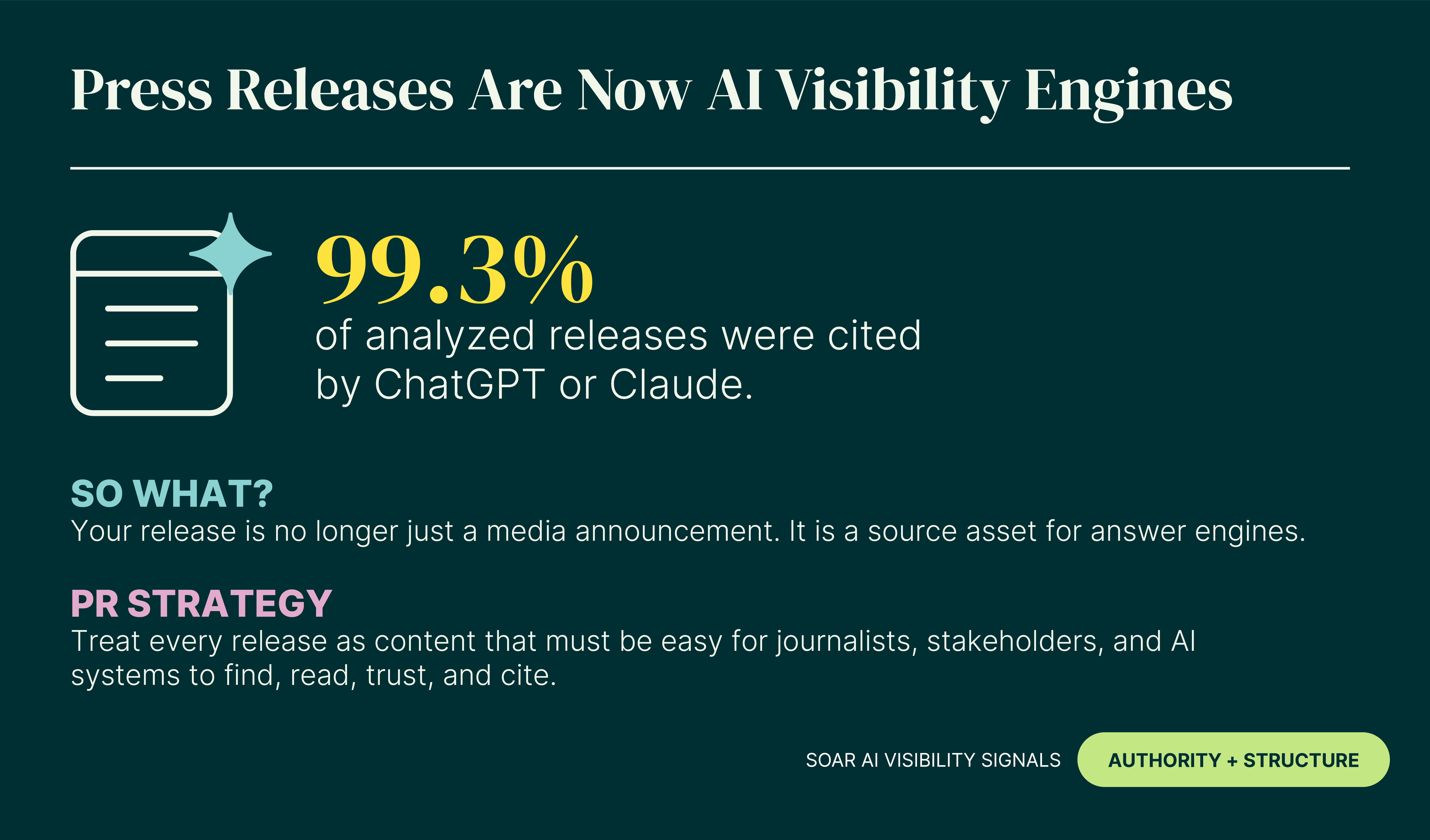
Across our dataset, 99.3% of press releases were cited by either ChatGPT or Claude – showing that in addition to general news distribution, releases distributed by trusted services like GlobeNewswire have become key for influencing AI answers.
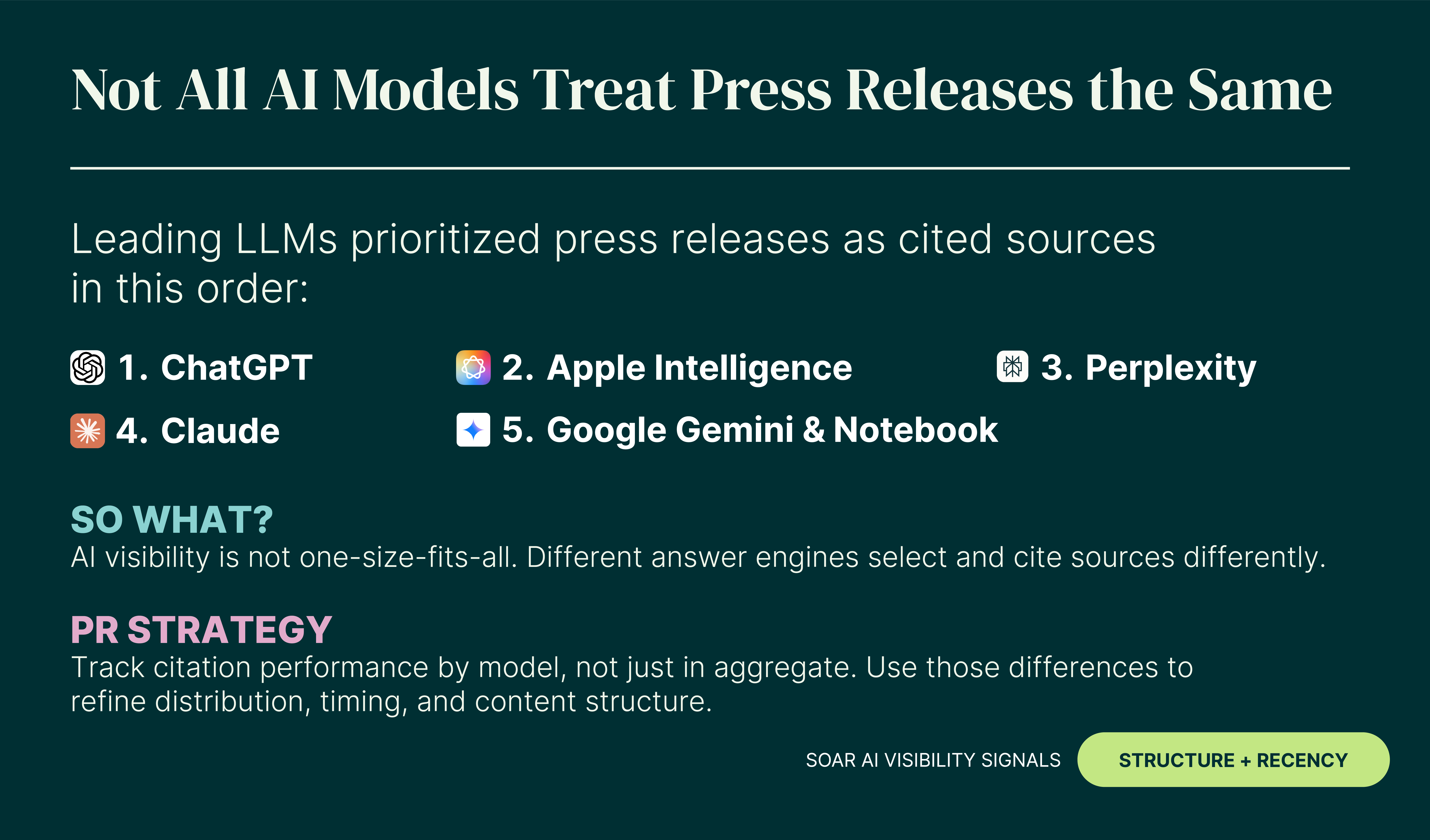
What also stood out was not just that releases were cited, but how citation patterns formed across leading AI platforms. Press releases were cited the most by ChatGPT, followed by Apple Intelligence, Perplexity, Claude and Google Gemini.
Today, your wire-distributed release is becoming one of the most reliable authority signals for AI, as success metrics shift from reach and coverage to inclusion in the answer.
2. AI Citation Momentum Forms Earlier Than Most Teams Expect
AI has become an “always-on news editor,” continuously indexing, synthesizing and surfacing information about your company from across the web in response to queries.
While the tried-and-true tactics of PR still have their place in the mix – relationships, exclusives, pitching and embargoes – AI systems now make decisions in essentially real time, with no slow news days.
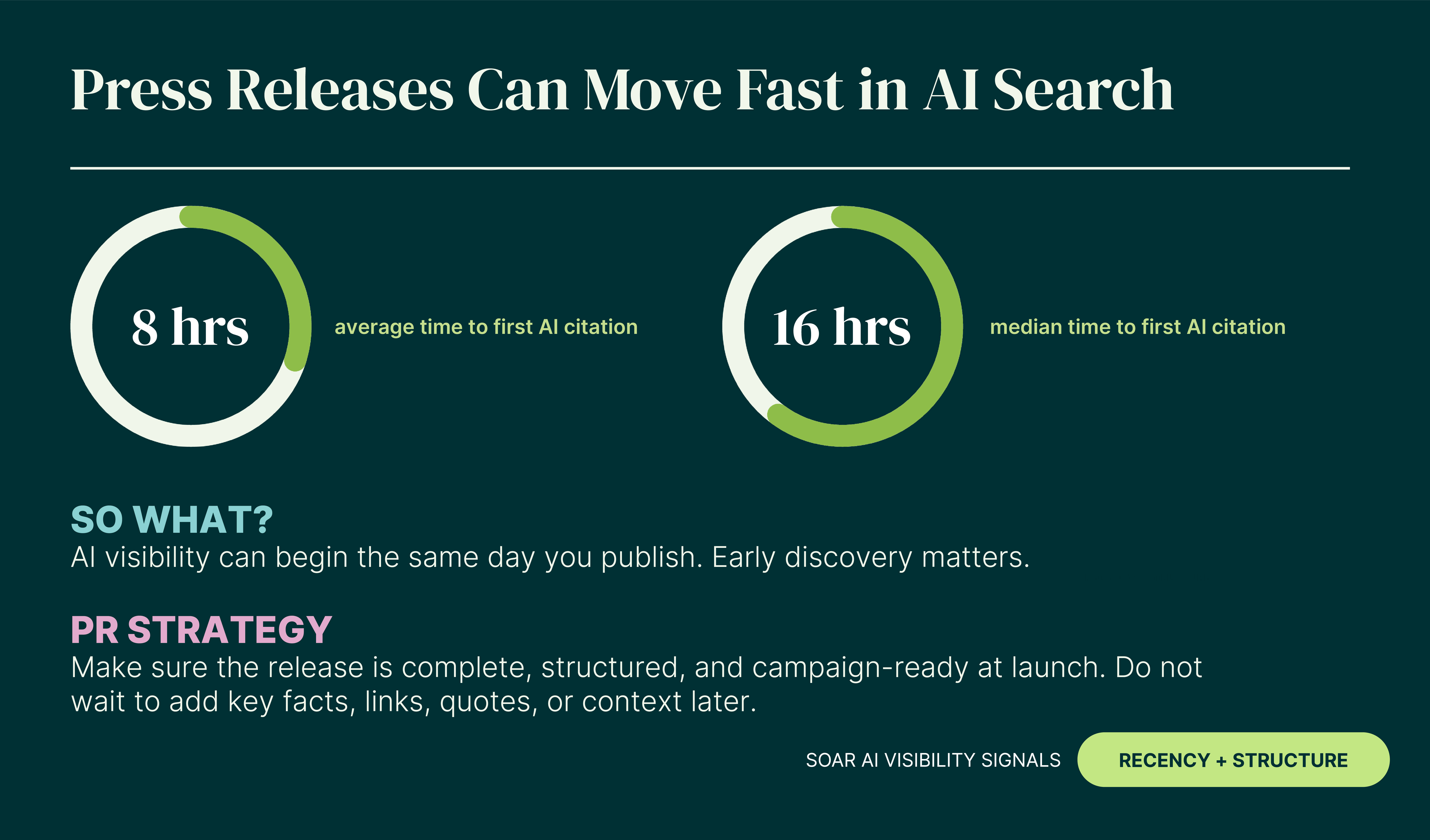
In fact, our research revealed the average time to first citation was just eight hours, with 17% of AI citations happening in the first 24 hours.
Visibility is no longer something that builds gradually over time or is based on media cycles. It’s increasingly established early, then reinforced.
A release that gains traction quickly is far more likely to sustain visibility, making early momentum a leading indicator of long-term performance.
3. Press Releases Help Anchor and Validate the Broader Narrative
Press releases don’t just operate in isolation. They’re part of the broader content ecosystem around them.
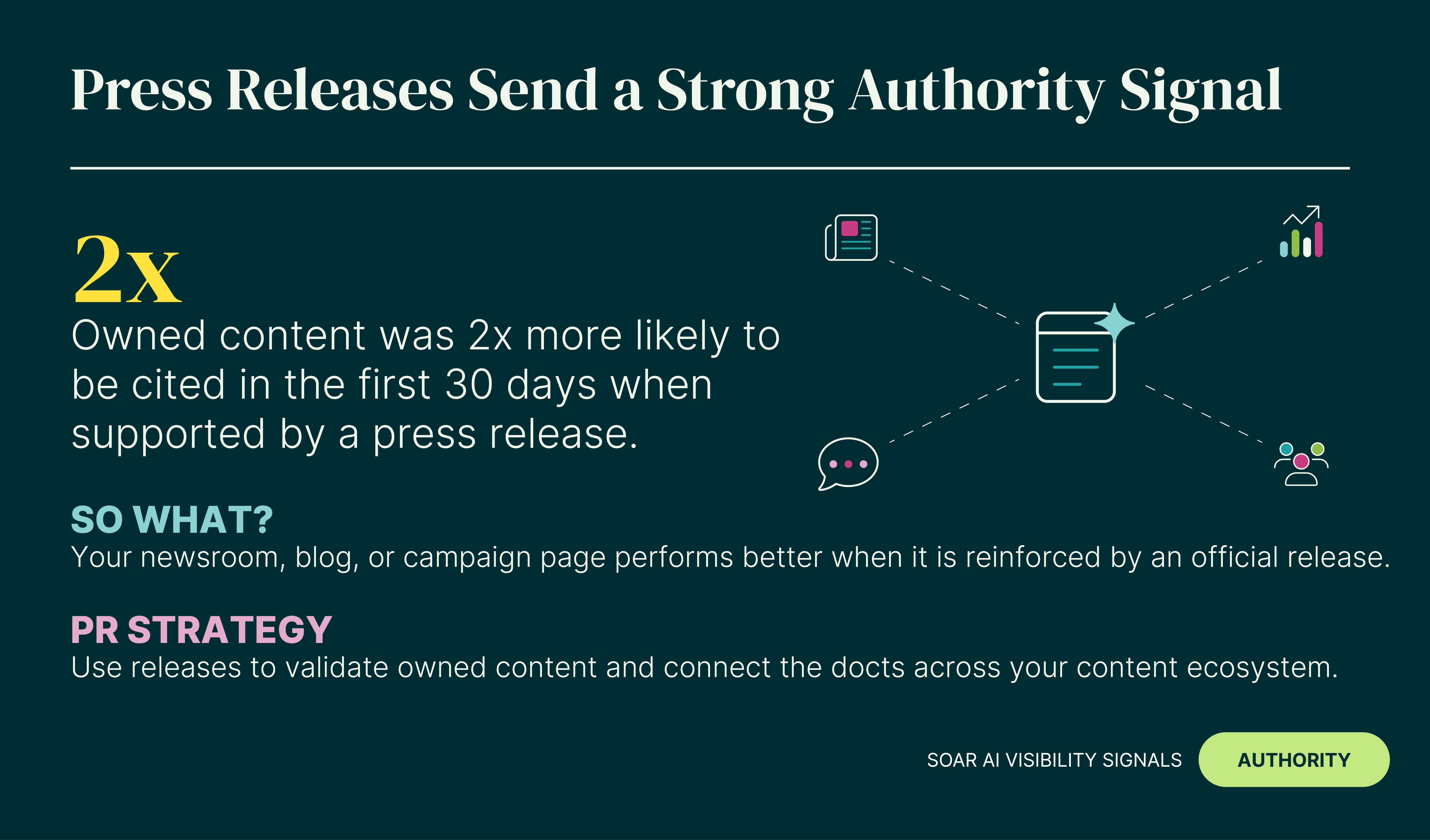
In our analysis, owned content – a newsroom, blog or campaign page - was twice as likely to be cited in the first 30 days when it was supported by a press release.
That tells us a release is doing more than just announcing your news. It’s establishing a canonical version of the story - one that helps reinforce how all additional PR content based upon the same core narrative is surfaced and trusted.
This matters in an environment where AI systems are trying to synthesize a coherent answer from multiple sources.
When there is a clear, authoritative anchor, the rest of your story becomes easier to validate.
So instead of thinking about your press release as a single output, it’s more useful to think of it as narrative infrastructure - something that fortifies and legitimizes everything built around it.
4. Multi-Language Press Release Distribution Expands AI Visibility
The world speaks in multiple languages, and so does AI.
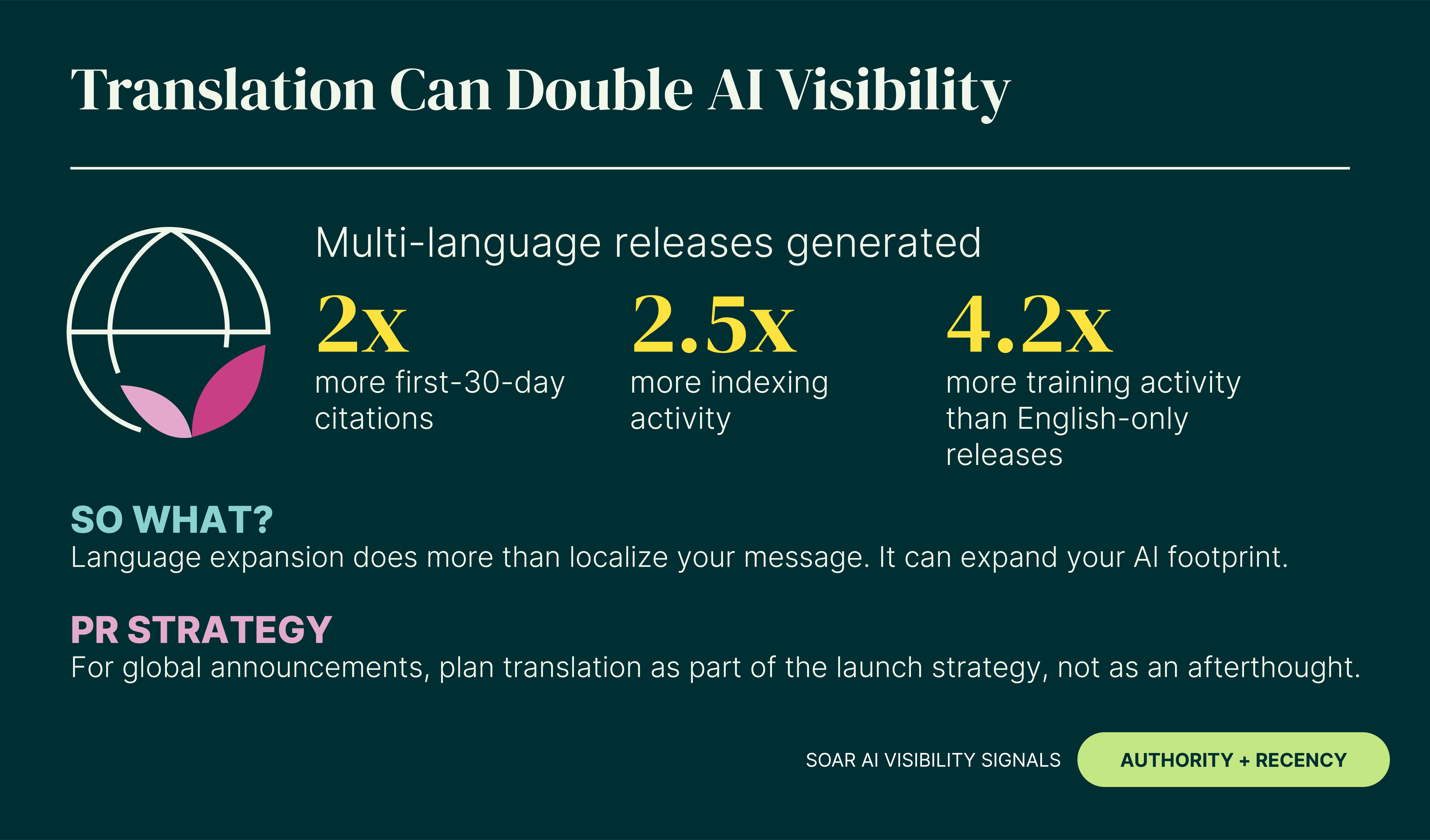
We uncovered that multi-language releases generated twice as many citations in the first 30 days compared to English-only distribution.
This suggests translation does more than localize your message - it expands your overall AI footprint and increases the likelihood of being discovered, cited and reused.
While English remains the baseline for most releases, expanding beyond a single language can significantly increase how widely your content is surfaced and cited across AI systems.
That’s especially important for global brands.
As answer engines evolve, visibility is not just becoming faster - it’s becoming more distributed, contextual and shaped by how broadly your content is understood.
5. Even Small Optimizations Can Create a Measurable Lift
Optimizing release content for AI is one of the most important – and controllable – steps you should take, from refining structure to elevating original insights.
Even minor improvements can have a major impact.
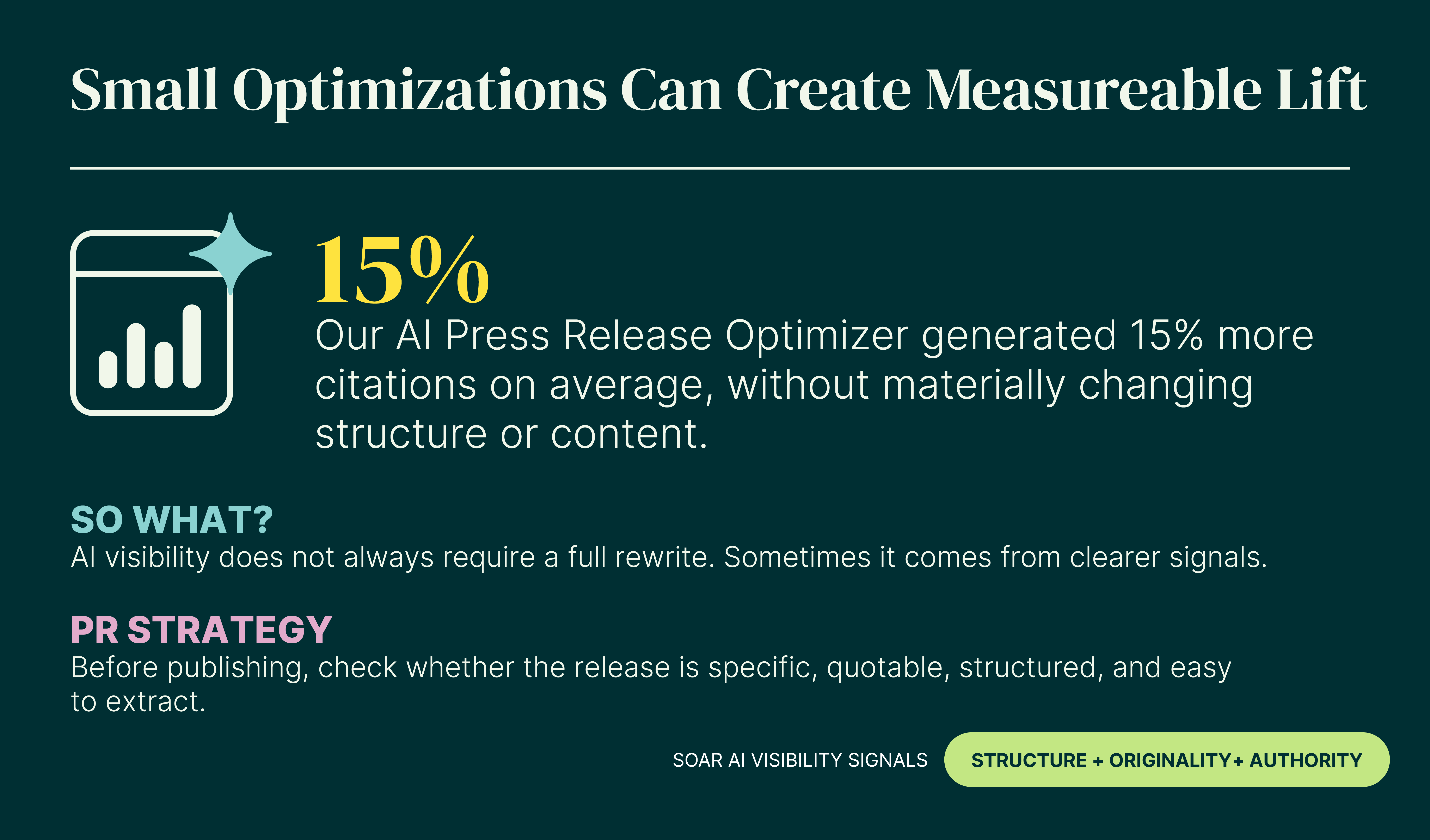
In our study, enhanced releases generated roughly 15% more citations on average without materially changing the underlying message.
This highlights an important point: improving AI visibility does not always require rewriting your message. In many cases, it comes down to making that message simply easier for systems to interpret.
The easier the content is to extract and interpret, the more likely it is to be trusted and reused.
With our AI Press Release Optimizer in Content OS TM, you can quickly increase citation potential before your release goes live directly in the GlobeNewswire distribution workflow.
It lets you upload draft content and review AI-powered recommendations within the platform, so you don’t have to switch between disconnected tools.
Moving Forward: The Opportunity for PR Teams
AI is not diminishing the value of public relations – in fact, it's increasing it.
As AI platforms play a larger role in how information is discovered and summarized, they rely on the same signals that have always been core to the profession.
Each day, PR teams help organizations tell accurate stories, provide context, establish credibility and build trust with audiences. Our research suggests those same strengths increasingly shape how AI systems understand and represent companies.
The technology may be changing, but the fundamentals are not. And that is the opportunity - not only for press releases, but for all content published online.
In a world where AI is shaping the answers people see first, the organizations with the clearest, most well-structured and credible stories will have the strongest voice.
Download the Report for More Insights
Explore the full findings to learn more about how AI systems discover, assess and cite news content.
Industry-First Research into AI Visibility for Press Releases
Download the new report to build optimized content LLMs love.

About Notified
Notified, Equiniti’s market engagement business, helps public relations and investor relations professionals earn attention, measure engagement and deliver results through its integrated platforms Content OS™ and IR Hub™. Click here to learn why more than 50% of the S&P 500 trust Notified’s solutions and services to drive demand and attract capital.
How tonies Brought Its Investment Story to Life for Investors Everywhere
Why AI Visibility Measurement Belongs to Public Relations