

Share this
by The Notified Team on Aug 26, 2026, 10:02:00 AM
Buyers are discovering and evaluating brands without visiting their websites. Learn how to create content that earns authority across earned and owned media and proves its influence beyond the click.
In This Blog:
Your best-performing content might never generate a single website visit.
That is not to say it’s not still doing important work. It’s shaping how a buyer understands a problem. It’s introducing them to your brand and influence which company makes their shortlist. The disconnect is that most marketing reports would struggle to give that content any credit.
AI-generated answers, social feeds, podcasts, and private communities now give buyers more avenues than ever to research companies without visiting their websites. Even traditional search, the long time king of discovery, has been sending fewer people to the open web. Pew Research Center found that users clicked a traditional result during just 8% of Google searches featuring an AI summary, compared with 15% when no summary appeared.
This leaves marketers with two urgent questions: How do you earn visibility when discovery happens without a click? And how do you prove that your content is working when the buyer journey is increasingly difficult to nail down?
A strong search ranking still has value, but visibility now extends well beyond a link on a results page. Your content must be easy for AI systems to understand, credible enough to cite and distinctive enough to influence buyers before they reach your website. And on top of that, it also needs to appear across the earned and owned channels that help establish your brand as a trusted source.
During Winning AI Visibility with Content Marketing, Notified CEO Erik Carlson and SparkToro CEO and co-founder Amanda Natividad share a practical roadmap for adapting. Their advice covers both sides of the challenge: creating content that earns visibility in AI search and building a measurement model that accounts for influence beyond website traffic.
The click may be disappearing. The opportunity to shape the buyer’s decision is not.
What Is Zero-Click Search?
Zero-click search occurs when someone gets the information they need without visiting another website. The answer may appear in a featured snippet, an AI Overview or a response generated by an AI platform.
The same behaviour extends beyond search. A buyer might learn about a company through a LinkedIn post, hear it mentioned on a podcast, or receive a recommendation in a private Slack community. Each interaction can move the buyer closer to a decision without producing a trackable website visit.
AI is accelerating this shift by synthesizing information from multiple sources into a single answer. For many questions, the user no longer needs to evaluate a page of links. The platform handles the first round of research for them.
That puts more weight on the information AI systems can find about your company, the sources they trust and how they represent your story.
Why Are Website Clicks Declining?
Search engines, AI tools and social platforms are increasingly designed to answer questions within their own environments.
Even when these interactions generate traffic, analytics may not identify the source. Recommendations shared through private messages, community discussions and journeys across multiple devices can appear as direct traffic or remain invisible.
This creates a growing disconnect between what influences the buyer and what marketing can measure.
Analytics can report on the portion of the journey it sees. It cannot account for every interaction that helped a buyer recognize, trust or remember a brand.
Does Lower Traffic Mean Your Content Is Underperforming?
Not always.
Consider a buyer who sees your thought leadership on LinkedIn, hears your company discussed on a podcast, and receives a recommendation from a colleague. When that buyer is ready to act, they search for your company and visit your website.
Organic search may receive credit for the conversion, even though several earlier interactions built awareness and trust.
Traffic remains useful, but it needs context. A decline in broad informational traffic may matter less if branded search, qualified inquiries and pipeline continue to improve. Strong traffic numbers may also offer little business value if the content attracts visitors with no reason to engage further.
This question moves the conversation away from collecting platform metrics and toward the decisions those metrics should inform.
A clearer measurement model considers whether content is helping the right audience:
- Understand what your company does
- Trust your expertise
- Remember your brand when a need arises
- Choose you over another option
These outcomes are harder to capture in one dashboard, but they are much closer to what marketing is expected to accomplish.
How Is AI Changing Content Discovery?
Your website may no longer be a buyer’s first meaningful interaction with your brand.
That first impression might happen when an AI tool answers a category question, summarizes your research or recommends a short list of providers. It could also happen through a media article, social discussion or customer recommendation.
By the time someone reaches your website, they may already understand the category and have formed an initial opinion about your company. Your site must give that informed buyer a reason to continue the relationship.
This does not mean SEO or owned content is becoming less important. Google says its generative search features continue to rely on its core Search ranking and quality systems. Strong SEO fundamentals continue to support visibility.
What has changed is the range of possible outcomes. Content can now influence a buyer through an AI citation, summary or brand mention without producing an immediate website visit.
How Can Brands Improve Visibility in AI Search?
During the webinar, Erik outlines four factors that can help content earn visibility and citations in AI-generated answers: structure, originality, authority and recency. Together, they form The SOAR Content Framework™.
1. Structure: Make the Answer Easy to Find
Start with the information your audience came for. State the subject and key facts before adding background and supporting detail.
This approach helps readers scan the content and gives AI systems a clearer understanding of its subject. Descriptive headings, concise answers, and accurate metadata make the information easier to interpret.
Put it into practice:
- Answer the article’s main question near the beginning.
- Use descriptive headings based on the questions your audience asks.
- Include the who, what, when, where and why within the opening section when relevant.
- Check that your title, description and structured data accurately reflect the content.
2. Originality: Say What Only Your Organization Can Say
Originality gives AI tools a reason to select your content instead of another summary of widely available information.
Originality can come from proprietary data, customer insights, internal expertise or a point of view developed through direct experience. Your customer base can also reveal trends and stories that no other organization can tell in quite the same way.
Put it into practice:
- Pair original owned content with a timely press release.
- Use named experts and clear sourcing to support important claims.
- Pitch the strongest findings to relevant journalists and industry outlets.
- Adapt the story for social, executive and multimedia channels.
3. Authority: Support the Story Across Trusted Channels
An owned article gives your company space to explore an idea in depth. A press release, media coverage and expert commentary can reinforce that idea across additional sources.
This matters because AI systems draw on multiple sources when developing a response. Erik describes how authoritative distribution can strengthen the visibility of owned content:
This gives communicators a more strategic way to think about distribution. A press release can amplify original research, a company announcement or new thought leadership while connecting audiences to the owned content that provides greater depth.
The advantage comes from how the channels work together. Each asset should add evidence, context or perspective instead of repeating the same copy.
Put it into practice:
- Pair original owned content with a timely press release.
- Use named experts and clear sourcing to support important claims.
- Pitch the strongest findings to relevant journalists and industry outlets.
- Adapt the story for social, executive and multimedia channels.
4. Recency: Keep Important Content Working
AI search places a premium on current information. That does not mean updating every page constantly. It means identifying the content central to your brand narrative and keeping it accurate.
Review key articles, reports, product pages and newsroom content regularly. Update statistics, introduce new findings and revise claims that no longer reflect the market or your company’s position.
A press release can also introduce a meaningful update and provide a timely path back to the supporting owned content.
Put it into practice:
- Identify the content most important to your brand narrative.
- Set review dates based on how quickly the subject changes.
- Update the substance of the content, not only the publication date.
- Remove or revise pages that contain outdated claims.
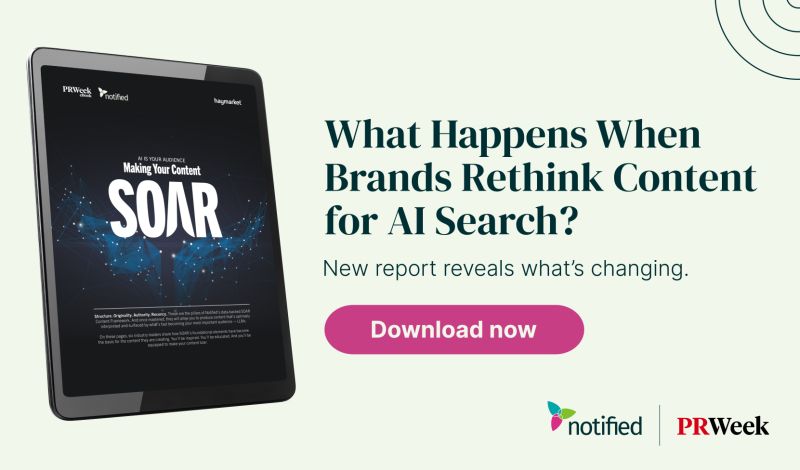
Make your content SOAR!
How brands like Chipotle, Ford, and Nestlé are adapting their content strategies to earn visibility in AI-generated answers.
How Can Earned and Owned Media Work Together?
Imagine your company has completed a new research report.
The owned report provides the full methodology, findings and analysis. A press release identifies the strongest news angle and makes the findings available through an established distribution network. Media outreach brings independent context to the story. Executive content explains why the findings matter to the market.
Each channel serves a distinct purpose:
- Owned content provides depth and evidence.
- Press release distribution makes the news timely and widely available.
- Earned coverage contributes outside context and credibility.
- Executive content gives the findings a recognizable point of view.
- Social content brings the insights directly into the environments where audiences spend time.
This coordinated approach creates more ways for buyers and AI systems to encounter, interpret and validate the story.
The objective is not publishing everywhere for the sake of volume. It is building a consistent body of credible information around the topics your company wants to own.
What Can Marketers Measure Beyond Clicks?
There is no single replacement for traffic or attribution. A stronger measurement model connects four types of evidence:
- Reach: Are the right audiences encountering the content?
- Audience: Are people choosing to follow, subscribe or hear from the brand again?
- Demand: Are branded searches, qualified visits and inquiries increasing?
- Business outcomes: Are pipeline, revenue, win rates or retention improving?
Reach and audience growth are leading indicators. Marketers can then examine whether those signals rise alongside branded demand and business outcomes.
This gives leadership a clearer view of how the marketing system is performing without assigning every result to the final measurable interaction. It also leaves room to account for pricing changes, sales activity, seasonality and other factors that can influence business performance.
For PR pros this does not mean handing over your wins to the other side of the house. Instead, it offers the opportunity to work together to paint a fuller picture of your joint impact.
Bottom Line: Build for Discovery, Trust, and Recall
Clicks still matter. They simply reveal less about the buyer journey than they once did. Content now needs to work before, during and after the website visit. It must provide value in zero-click environments, give AI systems clear and credible information to use and help buyers remember the brand when they are ready to act.
For PR and content teams, the opportunity is to create stronger material and activate it more intentionally:
- Structure makes information easier to understand.
- Originality makes it worth citing.
- Authority builds confidence in the story.
- Recency keeps the story relevant.
The path to the buyer may be harder to track, but the strategy does not need to be harder to execute.
Watch Winning AI Visibility with Content Marketing for practical ways to improve content discoverability, strengthen visibility across earned and owned media and measure influence beyond the click.
About Notified
Notified, Equiniti’s market engagement business, helps public relations and investor relations professionals earn attention, measure engagement and deliver results through its integrated platforms Content OS™ and IR Hub™. Click here to learn why more than 50% of the S&P 500 trust Notified’s solutions and services to drive demand and attract capital.
Why AI Visibility Measurement Belongs to Public Relations

How to Measure AI Search Visibility Without Chasing a Score

3 Ways to Prevent AI Hallucinations Before They Shape Your Company's Story