

Share this
by The Notified Team on Nov 24, 2026, 11:36:05 AM
Ford, Chipotle, Nestlé, Ally Financial and other leading organizations are changing how they create and maintain content for an audience that already includes AI. Their approaches offer practical lessons for communicators working to make brand information clear, credible and useful wherever people search for answers.
Ford, Chipotle, Nestlé, Ally Financial and other leading organizations are changing how they create and maintain content for an audience that already includes AI. Their approaches offer practical lessons for communicators working to make brand information clear, credible and useful wherever people search for answers.
Press releases have always been built to travel. They move through distribution networks, newsrooms, search engines and media databases. They inform coverage, establish the public record and give stakeholders a direct source for company news.
Now they are also being found by AI.
When someone asks an AI platform about a company, product or industry issue, a press release can become source material for the answer. It may be retrieved and cited long after the initial news cycle, reaching audiences who never visited the company’s newsroom or saw the original announcement.
That extends the value of the press release while raising the standard for what it must deliver. Brand recognition, publishing frequency and distribution alone do not secure visibility in AI-generated answers. The content must clearly establish the news, the organization behind it and the significance of the development.
Research behind Notified’s AI Is Your Audience: Making Your Content Soar report with PRWeek makes the stakes clear. The research examined more than 250,000 press releases and nearly a quarter-billion AI citations. In one analysis, a release from a small-cap B2B company generated nearly four times as many citations over 30 days as one from a nationally recognized retail brand and a comparable peer control.
AI visibility is not simply an extension of brand awareness or media prominence. A lesser-known company can outperform a household name when its content provides stronger signals.
The report shows how Ally Financial, Chipotle Mexican Grill, Ford Motor Company, Nestlé, Sandy Hook Promise and Frantz Marketing Solutions put those signals to work. Their approaches differ, but each demonstrates how editorial discipline can extend the reach and staying power of corporate information.
Ally Financial Makes the Main Point Easy to Find
Ally Financial applies a straightforward editorial test: Can the audience quickly understand what the story is about, why it matters and what they should take from it?
As the PRWeek report puts it, “Humans skim content visually, machines parse content systematically.”
Ally’s approach is grounded in editorial hierarchy. The headline identifies the news. The opening establishes its significance. Supporting details add evidence without obscuring the central point.
That discipline makes the story easier to navigate while reducing ambiguity about the subject, organization and news value.
Notified’s supporting research, Written for People. Read by Machines., reinforces the relationship between clear organization and citation performance. Its analysis of more than 25,000 GlobeNewswire press releases and nearly one million AI citations found that presentation can influence how readily AI systems interpret and use the information.
Structure makes a release legible. Originality gives it something worth finding.
Build Stronger Content Signals
See how the SOAR framework helps content earn attention from people and AI.
Ford Turns Access Into Original Reporting
Ford Motor Company has access outside publishers and content aggregators cannot replicate. Its teams can draw on engineers, manufacturing operations, vehicle development, original media and decades of institutional knowledge.
The company’s From the Road platform turns that access into reporting. Its coverage of vehicles, communities and culture is rooted in people and expertise inside the organization, giving Ford a point of view that cannot be assembled from public information alone.
That distinction carries more weight as AI systems encounter large volumes of repetitive content. Firsthand reporting gives a company something defensible to contribute, but the originality must be evident. Proprietary data should be identified. Sources and credentials should be clear. Company milestones should specify what materially changed.
Corporate communications teams already possess expertise, data and access that others cannot reproduce. Ford shows how to turn those assets into substantive reporting rather than promotional content.
Original reporting strengthens an individual story. Sustained authority depends on what surrounds it.
Nestlé Builds Authority Across Connected Sources
A single press release can establish the news, but it rarely provides the complete record.
Nestlé connects announcements with expert perspectives, FAQs and maintained corporate pages. New developments sit within a broader body of information rather than appearing as isolated moments.
A release delivers the latest update. An owned page provides background. Expert material establishes the company’s experience with the subject. Together, they present a consistent and verifiable account.
That continuity strengthens the relationship between the organization and the topic. Authority accumulates through sustained coverage, specific attribution and clear connections between new information and established knowledge.
It also allows the press release to remain focused. The announcement carries the news, while the surrounding content provides the depth needed to understand and verify it.
Those connections build authority over time. The original release still determines the strength of the foundation.
The First Published Version Sets the Record
Frantz Marketing Solutions offers one of the most direct observations in the PRWeek report: “If a crawler can’t read it, an AI model can’t cite it.”
The first published version of a release can be indexed, syndicated, summarized and retrieved before a communications team has the opportunity to revise it. Any gaps can travel with the story.
A vague headline weakens the connection to the news. Critical facts contained only in an image or linked PDF can become detached from the release. Missing attribution makes claims harder to evaluate. An incomplete company description creates uncertainty about the organization’s role.
AI retrieval gives familiar editorial weaknesses a longer tail.
Hosted content should be updated as facts change or new context becomes available, particularly when an announcement has a long shelf life. But maintenance does not replace a rigorous pre-publication review. The original release should stand on its own as the clearest and most authoritative account of the news.
What Drives AI Citations?
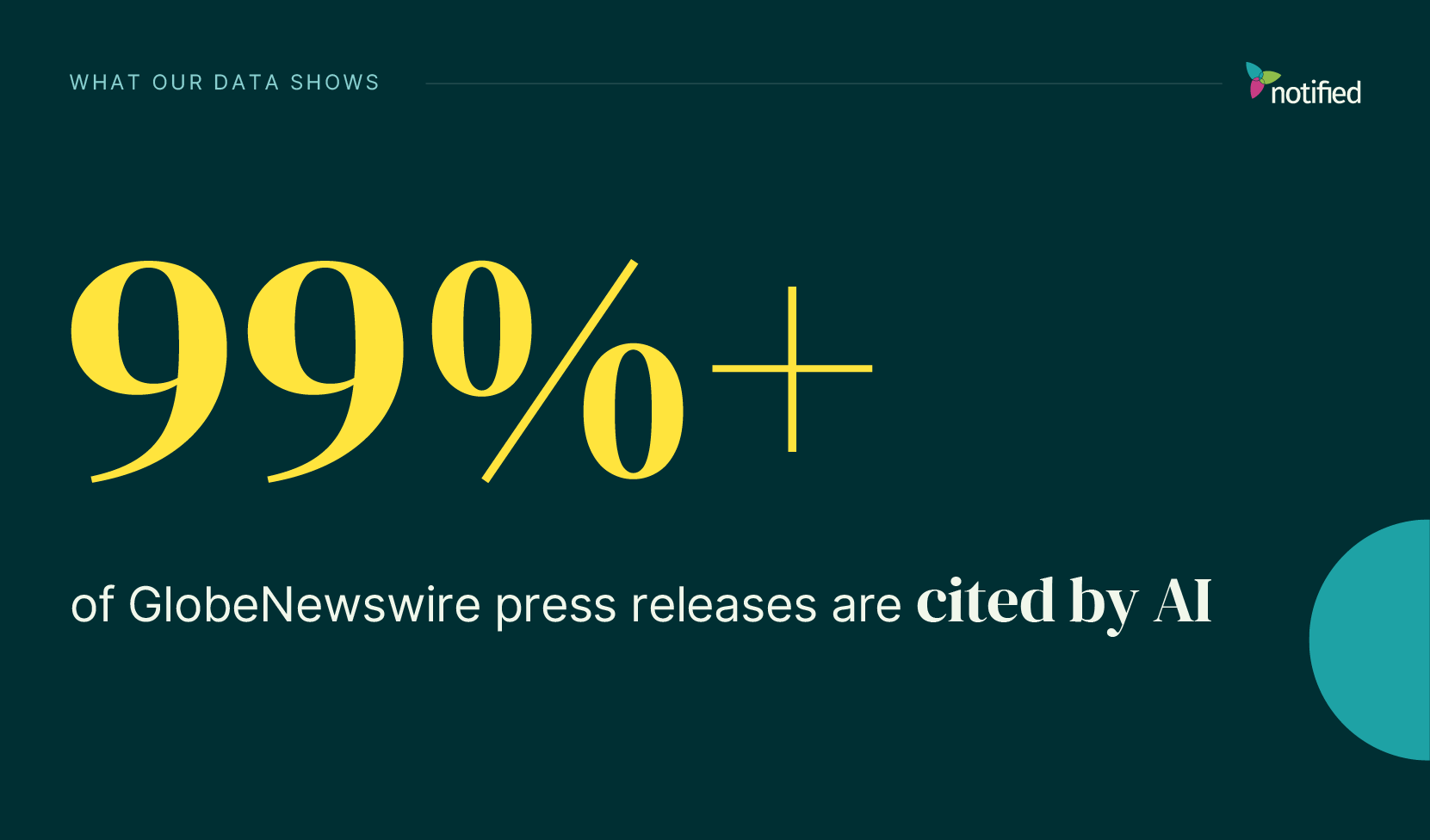
See what nearly one million citations reveal about AI visibility.
Better AI Visibility Starts With Better PR
The examples in the PRWeek report do not call for a new style of writing designed around machines. They show how established PR practices gain strategic value when content is being retrieved and interpreted by AI.
Ally Financial establishes a clear editorial hierarchy. Ford turns internal access into original reporting. Nestlé builds authority across connected sources. Frantz Marketing Solutions protects the integrity of the original published record.
These practices reflect the four pillars of Notified’s SOAR Content Framework: Structure, Originality, Authority and Recency. The framework assesses whether published content provides enough substance to be understood, verified and used.
The findings from Written for People. Read by Machines. add further evidence. AI systems differ in how they discover and cite corporate information, but clear reporting, attributable expertise and specific evidence strengthen a release wherever it is found.
Press releases are no longer confined to the audiences, channels or timelines that shaped their original distribution. They are becoming part of the information layer AI systems use to answer questions about companies and industries.
The advantage will not necessarily go to the organizations publishing the most. It will go to those giving AI the strongest material to work with.
See How Leading Communicators Are Adapting Content for AI
The examples above cover only part of what these organizations shared. AI Is Your Audience: Making Your Content Soar takes a closer look at how Ally Financial, Chipotle Mexican Grill, Ford Motor Company, Frantz Marketing Solutions, Nestlé and Sandy Hook Promise are approaching Structure, Originality, Authority and Recency as AI plays a larger role in information discovery.
Download the report for the complete case studies, expert perspectives and practical guidance for strengthening content for human readers and AI systems.

About Notified
Notified, Equiniti’s market engagement business, helps public relations and investor relations professionals earn attention, measure engagement and deliver results through its integrated platforms Content OS™ and IR Hub™. Click here to learn why more than 50% of the S&P 500 trust Notified’s solutions and services to drive demand and attract capital.

AI Doesn't Want More Content. It Wants Better Signals.

How ATEC Spine Restored Confidence in Earnings Day

Content OS Updates: Helping PR Teams Improve AI Visibility, Distribution and Measurement