

Share this
by The Notified Team on Jan 28, 2026 7:09:30 PM
Key Facts:- Press releases are uniquely trusted by AI - they earn visibility that blogs and social posts often don’t.
- It’s important to structure content for AI discovery, from clear headlines to easily readable sections and consistent updates.
- AI tools should be used to refine, not replace, your writing.
Are journalists, customers and key stakeholders finding your press releases across AI search and answer engines?
That was the core question we explored during our recent webinar with MarketingProfs: Meet Your New AEO Ally: The Press Release.
Hosted by Michael J. Lamp, the session brought together Lisa Davis, VP of Marketing at Notified, and PR strategist Jeffrey G. Thomas to unpack how AI is changing the way information is discovered, summarized and trusted - and why the press release still plays a critical role.
Keep reading to learn what’s working when your audience includes both humans and machines!

Why Press Releases Earn AI Trust
AI tools don’t “think” - they evaluate risk.
When someone asks ChatGPT, Gemini or Perplexity a question, the model looks for information that feels official, factual and safe to reuse. That’s why press releases consistently rise to the top.
During the webinar, Lisa explained that press releases already do what AI needs them to do. They answer questions directly, follow a predictable structure and come from verified sources - all strong trust signals for answer engines.
Because press releases clearly state who did what, when and why, AI doesn’t have to interpret or guess. Published on owned domains and trusted wire services, they’re designed to be understood quickly - not skimmed, not debated.
For AI models built to minimize risk, that clarity and consistency make press releases one of the safest formats to cite.
You Don't Need "Big News" To Show Up in AI
Another key takeaway from the session: AI visibility isn’t tied to big headlines.
For earned media, major announcements still matter. But AI plays by a different set of rules.
As Davis noted, content doesn’t need to break through a news cycle to be useful to answer engines. What matters more is how often you publish and how clearly your information is structured. In short, cadence beats hype.
Smaller, consistent updates help AI understand what your brand stands for over time. They reinforce key messages, correct outdated information and give answer engines fresh, reliable content to pull from.
That’s why press releases work best when they’re treated as an ongoing visibility tool - not a one-off announcement tied only to “big moments.”
Press Release Structure Matters - But Humans Still Matter, Too
A common concern raised during the webinar was whether AI-optimized press releases have to sacrifice readability. The answer was “no.”
As Jeffrey G. Thomas put it, we now have both machines and human gatekeepers. Press releases don’t have to choose between the two. Give AI what it needs at the top and bottom and still write clearly and thoughtfully in the middle.
That structure doesn’t just help answer engines. It also helps teams stay aligned.
Clear, structured releases make it easier for PR, content and marketing teams to work from the same facts, language, and timing - which matters more than ever in an AI-driven environment.
As Thomas warned, “AI is already gatekeeping enough. If we keep insights siloed inside teams, we’re just making visibility harder for ourselves.”
When teams share what they’re learning, the questions AI surfaces, which phrasing gets cited and which content holds up - everyone writes more clearly, consistently, and with less risk.
Watch the Full Webinar On Demand
Want to access the entire conversation and get more examples?
Watch the full session and dive deeper into how AI evaluates content, where answer engines actually pull information from and how you can adapt without losing your voice.
Watch On Demand
Learn how to turn the press release into a pillar of your content strategy.
Notified + MarketingProfs Webinar Transcript: Meet Your New AEO Ally - The Press Release
Jeffrey G. Thomas: Hello everyone, and welcome to today's webinar, Meet Your New AEO Ally: The Press Release, produced by MarketingProfs and sponsored by Notified. I'm Jeffrey G. Thomas, and I'll be your moderator for today's event.
Before we begin, a few updates and housekeeping notes. If you experience any audio or visual problems, please try refreshing your page or logging out and logging back in again. If you're on Wi-Fi or have multiple applications open, it could impact your viewing experience. So, when in doubt - close it out.
Check out the right-hand side panel for so, me fun engagement options. You can use the chat to connect with fellow marketers, and you can reply and send reactions to other comments by hovering over them. Please use the Q&A tab to submit questions for our speakers. You can also upvote your favorite questions there. As soon as today's presentation is done, we'll get to as many questions as we can - starting with the most popular ones.
There's also a PDF of the deck available just below the Q&A tab in the Resources tab, along with a great case study. And if you look at the bottom of the screen, you'll see emoji buttons. Please feel free to share your reactions throughout today's presentation.
I'd like to take a minute to thank Notified for sponsoring today's webinar. Notified helps you control and amplify your corporate narrative: research and reach the right media, send targeted press releases with GlobeNewswire, and measure your impact - all from one integrated PR platform.
Now please join me in welcoming Lisa Davis and Michael J. Lamp, who are presenting Meet Your New AEO Ally: The Press Release. Lisa is Vice President of Marketing at Notified, where she leads growth marketing initiatives. With more than 20 years of experience in B2B communications, her leadership delivers measurable value through demand generation and digital campaigns.
Michael is a dynamic digital leader with over 15 years of experience in public relations and digital marketing. He currently serves as Chief Digital Officer at Hunter and has been recognized as one of PRWeek's 40 Under 40 and PRSA New York's 15 Under 35.
And with that, I'm going to hand it over. Lisa, Michael - please take it away.
Lisa Davis: Hi everyone. Happy holidays. Michael, you're looking very festive - so festive.
Michael J. Lamp: Season’s greetings. Thank you very much.
Lisa Davis: All right. For everyone who's tuned in today, thank you, thank you for spending some time with us. Really quickly, here's what we're going to cover today:
We're going to look at large language models (LLMs) and why they love press releases. We're going to cover how to shape and optimize your content so that AI trusts you and your brand. And we're going to get some tips for being cited by AI engines - because that is something more and more of us want.
We're going to keep this as a fireside chat-style conversation between Michael and me. We've got some slides, but this is not going to be a 50-slide deck. So, I’d love to get started.
I come to this with an interesting perspective because I'm on the marketing side and Michael is more on the PR side. Together, this conversation is very well timed because there is such a coming together of these two disciplines.
When you think about it, for so many of us on the marketing side and the PR side, our plans for 2026 are so different going into this year than they were going into last year - particularly when you think about budgets, cultivating brand awareness, and search visibility.
There’s a slide in this deck - and if you've seen this graph or one like it - we've all seen the trend of traditional search on the decline and AI search on the rise. A lot of folks believe that traffic from LLMs will soon surpass traffic from traditional organic search. For many of us on this call, that completely upends a lot of what we've learned to do and how we've learned to optimize and write content.
So, what does visibility mean for marketers today? I think what we all have in common is that we want our brands to be seen and cited in AI search. When somebody types a question, we want to be the answer. When someone is looking for a solution, we want to be the answer.
For a lot of folks on this call, a press release might not be high on your list of content marketing tactics for growing AI visibility or as part of your AEO strategy. But I think after 45 minutes today, we'll have you convinced that it should be.
We do have a poll we're going to kick off, but before we do - Michael, thank you for joining us. We've had a few great conversations leading up to this, so, I'm really looking forward to this. I’ll throw it over to you for a bit.
Michael J. Lamp: Yeah, I'm very happy to be here. I wish we could have recorded the pre-conversations - there was already such good stuff for everyone to hear - but we're going to bring all of that into the next 45 minutes.
The slide that was just shown - and we'll segue into the poll in a moment - reminds me of that old SAT question: “When a train leaves here and another leaves there, where do they meet?” That’s kind of what this moment feels like.
It’s also a great visual aid for the big question of SEO to AEO, or GEO - it’s very “Old MacDonald had a farm, E-I-E-I-O,” right? Whether you call it Answer Engine Optimization or Generative Engine Optimization, the good news is you optimize the same way.
So, the tips we'll go through when we get more into the “how” with press releases are about optimizing for these answer engines. But the phrase I’d like to bring back - and one I’ve been seeing that I think really wins the day - is that it's still SEO. It's just Search Everywhere Optimization.
Even before this AI search conversation, we were talking about TikTok as a search engine - how Gen Z goes to TikTok instead of Google. It’s really about where we searched yesterday, where we search today, and where we’ll search tomorrow.
That's why, when we get into things like zero-click behaviors - which have ushered in this step change - it matters. People don’t want a long list of links anymore. They just want answers. That’s the biggest thing to understand we are optimizing press releases to answer how people get information now. They expect to ask a question and have it answered - not be given a list they need to sift through for months.
And a shout-out - I saw Tennessee and Ohio in the chat. I grew up in West Virginia, so, hello neighbors in Ohio. I also saw Kansas City - hello! Happy to be with you all. Let’s keep going.
Lisa Davis: All right - do we want to pop up that poll?
Michael J. Lamp: Yeah, let's do it.
Lisa Davis: Got it. I don’t need to read this to you, but it helps set the stage. I’m assuming a large ratio of marketers on this call, though I know there are some PR and comms folks as well. We’re curious about your current involvement in press releases.
Would you say you or your team are involved - creating them, writing them, optimizing them, reviewing performance? Or are you aware of them but not really involved? Or do you have no involvement at all?
Michael J. Lamp: So far, based on early responses - and hopefully once you vote, you can see the answers - it looks like more than three-quarters of folks are involved in some major way.
Lisa Davis: Excellent, excellent. so, you know, look, I mean, I think that any answer would have been helpful for this conversation, but I think knowing the involvement that folks have, I think that sets us up for a really good conversation of how you can optimize what you're doing today and maybe lean in a little more closely, right, to the process of creation and measurement. So, you know, Michael, I'm going to throw it right over to you and ask the question that we've got in the agenda. What is it about a press release that LLMs love? So, whether it’s ChatGPT, CoPilot, whatever your AI engine of choice is - what is it about a press release that makes it such a good fuel for AI search?
Michael J. Lamp: Okay, so, this is the $1,000,000 question, right? I mean, I think the number one answer, short answer, is press releases are hubs for the why and the how, right? You've got news to release, right? You need to provide with the first three letters in news - it's new. so, it's some sort of information that is not yet known to its public. That's a good PR 101 definition. Props to my PR teachers back in college. But it's sort of not just what you're announcing, but why. And if you're really doing it smartly - and this is the step change, I would say, from Web 2.0 to 3.0 - it's the how, right? It's the steps in the process. It's not just the reason why this news matters today, but how you can utilize this news.
These foundational arbiters of information… and I want to get into some of the how and not belabor the point any longer, but one of the slides that we have is more on “welcome to this era that we're in” that I want to just quickly review with the group so that we can kind of go back in time. I often - sorry to make you go back a little bit with all my overt animations - but this is, I like this slide because it's sort of the, I like to say, if we were in a movie right now, this would be the “you're probably wondering how I got here,” right back in time. And so, this is sort of the history of the internet, one slide, from yours truly, right? I don't want to spend too much time, but there is an important takeaway here.
And that is that the omnipresent KPI, if you want to call it that, in the history of the internet has been visibility. Billboards of the internet era were websites, right? It was where, oh, we could have a website like a billboard, you know, IRL is put online. It was about being seen. Then the social era comes around. It's still about visibility, but in these gated communities - Facebooks, the Twitters, the Instagrams of the world - it mattered more. And now it's visibility still, but it's by these machines that have outsized value in delivering an answer to people, right?
So, we can pop from this slide because I think it's, again, it's just… and we'll share some of this with you all afterwards if it's valuable. This is, I think, a really good… oh, Upstate New York, Houston, Texas in the chat, Pittsburgh. I went to school an hour south of Pittsburgh at WVU. We're really representative here. I saw LA earlier.
This gets a little into the how, right? So, before we jump into some of the pro tips that both Lisa and I have for you - I love this study from Muck Rack that talks about how 96% of information that LLMs see and thus fetch to people, they get from earned or owned. And when we say owned, I don't even mean social in today’s broad definition, although we know that there are places like Reddit where LLMs can see a lot. I'm talking the original owned - the website, the corporate blog, right?
So, if that's what, right, those are the things using my own words to define it as well… what in terms of what matters. These rows are how, right? So, we know that people look for sequenced information. There's a reason why MapQuest is still often cited by LLMs, despite the fact that Gen Z is kind of like, what is that thing? I remember the days of Map Questing my directions to Hershey Park and then using a highlighter. But the point is, it's a step-by-step instruction of a means to an end - get here from there. And so, that's the type of information with authority and trust that they want to deliver.
The only other one I'll call out is comparative evaluation. People don't just say, I need information on hot sauce. They say, compare the two best hot sauces and give me a recommendation. That's how we search on AI. And so, in our press materials, we have to think like the ultimate end, right? The person who's looking for the information - what are they desiring? - and then stitch backward.
So, we can go to the next slide. Now, back to… this I already spoke about. This is kind of our, like, where we are, right? The rules of discovery - machines and humans - we have to optimize for both of those. We have dual gatekeepers, search everywhere optimization, and we’re in this post-click world, right? Profound is a tech leader in this space, and they talk a lot about living in a zero-click world.
So, this slide, again, we'll provide it. It may be good - I recommend a screenshot here - if you want a sort of reference guide. Lisa has an amazing one as well on the SOAR framework coming up in a moment. But this is how we get into workshops with our clients. And we start to say, okay, it's one thing to understand the theory of a press release driving traction and driving LLM visibility. It's another thing to do it, right?
So, without spending all the time in the world, you know, we talk about things like the return of the FAQ. You've heard a lot of people probably talk about that, right? I've done deep analysis of some websites in various categories and seen the domain leaders in a topic being directly, direct-line connected to the fact that they have FAQs, not just in general, but thematic FAQs that match what people are searching, right? It's a very simple silver bullet.
When we talk about building context - this is one of my favorite “go do this today” press release tips. And just sort of in general, when you're developing communication and content for the agentic era, I'm always advising our teams and our clients to think in three columns, right? Semantic, contextual, authoritative.
The reason why that's so important is because semantic is table stakes, right? If you're in financial communications, what are the words and phrases that are simply always searched or talked about in financial communications? Contextual, right? The big enemy of machines is context because they're void of it, right? We're humans - we can put it back in there.
So, if we fill our press materials with context - what makes us special? so, a financial comms client, maybe a brand… the table stakes stuff… and what are your points of difference, right? What makes you different from the competitors? Put that there.
And then authoritative - prove it out. An LLM doesn't care just because you say so, right? They need the old Reading Rainbow “don’t take my word for it.” And so, link to someone else who's validating your data. Link to a survey point, right? Whatever it might be. Those are the ways that you can show that you exist in space, you're special and a leader in the space, and that you're validated by those who are already believed by LLMs, right?
So, I won't spend any more time on this slide. Know that this will be provided to you, but the whole point is - LLMs are not a part of your marketing strategy. You are trying to create marketing materials and press materials to be seen by them, to ingest and remix it on their terms.
This slide I'll talk about quickly before - I want to make sure that Lisa gets to share some wonderful visual aids as well. This is just a marked-up press release that we did with some of my colleagues in the UK. We're looking at not a client but looking at a release from Kellogg's. What do we love? Well, the old TLDR, right? “Too long, didn’t read.” In case these things, you know, they can crawl completely, but they also look for blocks of text.
We have a tool that we upload releases into that we've built through the marketing cloud, different agents that we've built for our teams and clients, and we can actually scan it to see which blocks of text it will see. And that helps us to know, okay, well, if we didn’t see this whole piece of prose because it's a dense paragraph, let's turn it into bullets and see if it's seen again, right?
So, whether it's bullets, whether it's trusted third-party endorsements - those are things we want to see, and we want to see bullets above the first paragraph, right? So, it's kind of headline, subheading, and then the things you need to know about this press release. But there are ways to increase this efficacy even further.
I bring in some FAQs. How could we turn an FAQ into a subheading that maybe leads each of these prose pieces? So, actually you're telling these LLMs - this is a press release, So, it's authoritative. It's not just what, but it's the how. And also this what and how answers these questions that people want to know, right? So, suddenly you're telling it all the things it wants to see.
But let's… I know I'm kind of getting into it already, but I want to make sure that we can go through that SOAR stuff because that is the framework that you provided. But I think it complements everything I was saying - if anything, it just spells it out a little bit more deeply.
Lisa Davis: Yeah, of course, right? So, I mean, you know, a lot of what you talked about - trust, context, authority, structure of content - all of those things, right? I think a lot of folks on this call take that into account when they're writing content today, right? What makes me sound authoritative? What makes me sound truthful? What kind of context do I need to add, right?
But a question that we get a lot because we send so many press releases for so many different customers is - so, I know how to write a press release, at least I think I do… how can I create one that is AI-friendly, right? What's the difference between the kind of press release I'm writing today that follows the inverted pyramid and, you know, it's got links in it and it's got contact information - is that AI-friendly?
So, I'm going to talk about this SOAR content framework a little bit, and we'll talk about it specifically for press releases first, but these guiding principles, you know, also apply to pages on your website, FAQ, blogs, right? Any kind of content that AI can crawl, index, and cite.
So, we publish a lot of press releases on behalf of companies every single week. And part of the metrics that we now provide for them is - when a press release went out, how many citations did it have in AI search? How often did an AI engine see it, index it, and cite it? This is a metric that's really, really, really powerful and will start to become even more powerful in what we're looking to measure. It's actually powered by a partner that Michael just mentioned - it's Profound, right?
So, recently, our team did an exercise where we examined more than 200,000 of our customers' press releases and 13 million citations - so, a very, very deep data set. We wanted to look at trends, similarities, differences. What was it across this vast swath of press releases that really drove AI visibility?
What we found was there were specific signals in a press release that AI engines favor. That's what you see here - structure, originality, authority, and recency, right? Very much echoing what Michael just said.
So, you know, I want to dig into that just a little bit. I'm not going to read this slide, but what does it mean? What is structure? Structure is making content easy to understand, both for human readers - everything that you see on the page, on the screen - but everything that's on the back end as well, right? So, it's that invisible-to-the-naked-eye coding that AI engines can see and index and cite.
Structure is also the visible structure. It could be a bulleted list. It could be short paragraphs. Originality is making sure that the content and the press releases that you're producing is something that only you can say. You should be including statistics, proprietary data, right? Quotes with named individuals from your company, right?
And authority. Michael also touched on this, right? So, this is critically important - you need to be your own best voice and your own authoritative source. So, you should be the primary source for the information that you're publishing. It's also very important that if you have a press release or a piece of content, you're hosting it on your own domain, right? That is really, really, really starting to link you and your domain and your digital footprint to what AI is finding and surfacing, right?
And a shameless plug - what I will say is that press releases that go through a paid newswire have a tremendous amount of amplification and AI visibility.
Last would-be recency, right? So, how recent and how fresh is your content so that AI finds it time and time again, right? It's not necessarily about just producing more content - “more content every day, every day, more and more and more.” Yes, but also updating content that you have, right, and giving it that updated or that recency stamp.
And so, Michael showed an example of a press release with some markups, and I'm going to do the same. So, what does this SOAR framework look like with an actual press release? So, I've got a couple of slides here. This is a real press release from a company called American Battery Technology Company. And in the analysis, we did those 200,000 presses releases I was just talking about, this release from a company that maybe you've never heard of before was very highly cited in AI engines because of its structure.
So similar to what I was just talking about and what Michael shouted out, right, is - the headline and the sub-headline are very clear. There's a company name. It's talking about a very specific action or an impact. There are numbers and figures. You know, the very nice thing about a press release is it comes automatically with a date stamp, right? So, you're able to denote recency.
It's got an executive summary, key facts - like Michael’s TLDR, right? So, don't be afraid to stray away from what might be seen as the typical press release structure of long paragraph, long paragraph, long paragraph, the end, right? Think about bolded headers, think about bulleted lists, right? These things are all very, very, very attractive, both to humans and journalists and vectors looking at these on their screens - but more importantly, AI engines absolutely love this content.
So, Michael, I don't know if you want to add a little bit more to the structure and this methodology, because I would really like to tap in next about reputation in AI.
Michael J. Lamp: Yeah, we'll talk about that next. But I mean, this is… I love the way - I think these are great. Again, I'm sure this will be provided to everybody, but fabulous screenshot. Think about this as like a lesson in terms of templating too, right? Like where do you build your next press release from the ground up? These diagram boxes are a great way to sort of create what I've been saying a lot with folks now - what's your GEO punch list, right? What are the five things you need to do before you can hit publish, right?
So, think about those things. And we've already given you a few, whether it be the FAQs, the TLDRs, supporting data. There are also phrases that sound intimidating, but we're going to demystify them a bit for you, right? In addition to acronyms, like people talk about having the right schema, right, in the AI era. It's really just the way you're formatted, right? The way your stuff looks online.
And so, with a lot of our food clients right now, we're having deep discussions about recipe schema, right? So, like, to Lisa's point about being the arbiter of your own business and the authority of your own business and brand - if you are an ingredient-based food brand and you are not AI-friendly as a recipe engine, you're going to get way left behind, right?
So, you need to make sure that the entire formatting of the way you're talking about recipes follows all of this framework, right? But think about it anyway - a recipe lends itself nicely to LLMs, right? It's got data points, structured data, structured facts, sequencing of information, a lot of times links to multimedia. So, I think just worth mentioning in that case.
And obviously the last piece - recency. We love recency as comms pros because, again, the first three letters in news are new. The big macro change this is speaking to is the way that large language models have changed the way they conduct searches.
And what I mean by that is - for a while, all LLMs could know was their own knowledge graph, which is why for a long-time people would say, “Oh, well, ChatGPT is really fun, but it's not very recent. It's old data,” right? Because they typically had six-month-or-so lag times.
But then this thing called retrieval-augmented generation entered the fray, where it could mean a couple different things. Either you're plugging in a different knowledge base to that model So, it can search a different part of the web or a deeper focus. But also, it's allowed for these indexed modeling capabilities where it's sort of… not just Gemini, but it's Gemini and traditional Google search. It's ChatGPT and web search. So, that recency piece is so incredibly important for us, and it's why press releases with their timestamps and their dates - with literally, “this news was new at this moment, at this time” - it's catnip, I often say, for LLMs. And I do want to answer in voice over something that I was typing while Lisa was actually more present, but I saw a question, and I was very excited by it. It was talking about how, what if you go over a wire and the pickup of the release is limited, right? Are you still going to have the same value in an LLM?
I'd say first of all, in my experience, most really good wires doing work - Notified, for example - you get great pickup, first of all. But I think the purpose of it though is the inevitability of serving it up as a placement. What I was trying to explain in the comments was that if you put two releases out in successive weeks and one got picked up 100 times and one got picked up twice, you might still see the same visibility improvements for your brand because one of those pickups was a really LLM-friendly website or publisher, right?
So, what I think folks should be doing - where we spend a lot of time analyzing - is what I would call an afterburn or halo effect of a press release. It’s not only where did it get picked up, but if I ask an LLM 10 different prompts, which part of that press release pickup from any number of sites got pulled in as the answer? Because it's one thing for it to be “the answer to your question is this,” and it’s branded and sourced from the press release. It’s another thing for it to be a quote from a spokesperson, and it’s like four lines with a lot of context. So, there are different value props there, right? In terms of the saliency of the answer and the authority of the answer.
And if I see a press release that goes out over Notified, and I ask a bunch of queries, and I see one particular place where it was picked up dwarfing the rest in terms of answering different questions, then I’m making sure that I pay a lot more attention to that outlet in general. And every time I issue a release from then on, I’m ensuring that it gets picked up there to start with, right?
So, hopefully that helps answer the question around this fear of limitation, because again, it's more of their gatekeeping. Whether you make it past the gate once or 1000 times, you’re opening yourself up to people finding your answer.
Lisa Davis: Yeah. Just before we bridge over to the reputation discussion, Michael, what I find interesting when I talk to folks in PR, marketing and comms is while there's this little bit of angst around AI - what about ROI, how do I measure it - and we'll talk about that a little bit later. But I do think sometimes, once you get past the initial blush of the conversation, a lot of marketers, PR folks and content marketers realize that a lot of these principles have been part of their content creation and publishing process for a long time. There’s just a bit of a tune-up required to be a little bit more cognizant of what is done particularly for an AI agent, right?
But writing with the inverted pyramid, putting company names in headlines, using conversational language, using bullet points, making things visual and attractive to a human reader also, - surprise, surprise - works very well for optimizing it online and for AI, right? So, I think once you get a little bit deeper into the conversation, people start realizing, “Oh, okay, I already do a lot of this. What can I do just a little bit differently, or tighten those screws a little bit, to really take things to the next level?” Do you find that as well?
Michael J. Lamp: Yes, 100,000%. The thing I'd probably say the most - and I do so many of these GEO trainings every week now - is it’s like improv. It's “yes, and” right? It’s yes, and. So, it's SEO and this other thing. Or it's this SEO principle. Even when I go back to what I was mentioning about the power of a press release, it's not just what, but the why and the how.
Another tech partner that we have at Hunter that I like a lot in this space - Scrunch - Kevin from the Scrunch team posted on LinkedIn just yesterday about how if you're only focused on the why, you might be a little “yesterday SEO.” The how is what really makes the press release of 2025 and 2026 the arbiter of the LLM engine catnip. Because think about it - another thing we talk about, and there's a great study from OpenAI called “How People Use ChatGPT,” finally revealing that data. I highly recommend you seek it out.
What it revealed to us is that people have moved into this behavior - in addition to the post-click - called “ask and task.” Meaning they ask an LLM a question, and then they task it to do something with that information. So, literally there is the ask (the why), and then the do it (the how), right? I can tell you anecdotally - Claude was my sous chef for Thanksgiving this year because I asked it to take all the recipes I was using for my eight guests and then tell me the right order to cook things and how to manage my one oven in a New York City apartment with different temperature guides.
But the point is - yes, and. It’s search plus, plus, plus. That’s why I say “search everywhere optimization,” because the big piece in “everywhere” is AI search now.
Lisa Davis: Yeah. All right, so, then let's lean into your expertise. I really want to talk a little bit about reputation - building reputation, managing reputation, repairing reputation - and how everything that we're talking about today changes reputation management for PR and comms folks going into 2026.
Michael J. Lamp: Yeah, it's exciting, if not somewhat terrifying proposition, right? Because I think one of the questions I get asked the most when I do sessions like this or deeper training is misinformation - hallucinations. That’s the question. Hallucinations are essentially factual inaccuracies that LLMs propagate. They do that for a number of reasons - either because you've asked it a couple of times, it can't find the right answer, and it doesn't want you to hate it because it was trained to be a people-pleaser, So, it'll just make it up, right?
But that’s still a challenge. That is a huge reputational risk with comms pros and unfortunately, there is no quick LLM fix. If I ask Gemini a question right now about one of my clients and it brings up certifiable misinformation, I can't call “Gary Google” and say, hey, don't show that on Gemini - that’s not true. The way you go about it is the long tail. It’s basically everything we've talked about - plus, plus, plus. You get rid of misinformation in AI by teaching it what the correct information is.
And not for nothing, we know ads are coming to LLMs. What that will look like remains to be seen. I think context will again win the day. But even when ads are there, LLMs are essentially digging - they’re paleontologists digging through the information layers of the internet to give you what you need. And so if the so is fraught with misinformation, your brand is not on solid ground. You can't grow a tree from that.
So, you have to be focused on what is happening just below the surface - finding all those outlets that might be arbiters of misinformation, even unintentionally - and then work long tail. What’s the press release cadence going into 2026? How often should we be issuing a press release that we are then also publishing on our online newsroom, to Lisa's earlier point about owning your domain?
So, if we can segue to a quick slide, because we do have a framework at Hunter that I do want to show. And for what it's worth, a little research here, as my colleague Samara would say, “That’s my research,” you know. And in transparency as well, we announced High Five, which is our GEO framework last week, and we issued a wire with our friends at Notified.
I can tell you that only now, when we're in the infancy of this news being out there, can I do really good association modeling around that pickup to that query. And I could show you—I won't belabor the point now—but I could show you a bunch of screenshots on my phone where I asked some questions about GEO and even about High Five, and it would serve up answers that I could then see, through a source, were literally driven by this pickup from our Notified press release, which answered that question. So, that’s the spirit of—and the importance of—visibility reporting, which is what takes access to the first piece.
So, again, there are a bunch of different ways you could go about this. For us, this framework is the most comprehensive in getting what makes communication special, which is your ability to impact these stories, but then also make it sustainable, right? And we like to be agnostic of tech, So, we're using a bunch of different tools. I won't get into the details of them today, but we're essentially hunting for that white space.
In the category, what’s the visibility report of a given category? Which brands own the most branded responses to questions? Who’s turning up, in other words, and where are you not turning up? Okay, that’s a problem. So, then let's do some funnel mapping, right? Today we're here. This is where we need to be in a visibility report. So, let's highlight our story in a way that is optimized for LLMs. Really, everything Lisa and I have talked to you about in terms of the art of optimization goes right into highlight. It’s the FAQs, it’s the schema changes, it’s the quote pull-ups, it’s the authoritative stuff. All of that is how you tell a story differently than you would have before, because we’re in this agentic world and you’ve got to phrase it differently.
Then you hook the media, right? You still want to reach machines by the humans that are the most believed by them. We’re all humans talking about this today. So, if I can see for one of my clients that there’s a particular editor and a handful of outlets that have a ton more citations around keywords, I want to pitch them with exclusives. I want to give them opportunities to release the information.
Halo is the social and NPR piece, right? That’s when we say, okay, this press release did really well and got picked up, and it's answering a lot of questions. What can that mean for our social content engine? What should we be creating? Should we be answering some FAQs in our video content this week to do that, as an example?
And then “hold,” right? Hold is how you get to the pole position and then defend that authority. Sometimes it takes a long time to get there, but that’s when we're literally looking at things like how often you are a branded answer, how visible you are, and how often you are a domain referral.
So, again, I just wanted to show you how, because I thought it would be good for you to hear me talk through how we do that. The idea is that from 1 to 5, you’ve found the challenge, written to solve it, found the best friends to help sell that story, and then moved into the two-way street of earned and owned to scale it even further.
So, I think there's one more slide on benchmarking, which I think was going to be our last question anyway. I know we're coming up on time. So, really quickly, maybe I’ll just show it So, people can see the slide and know that it will be sent to you. I’m not going to drain this, because I do want to spend our last 10 minutes answering some great questions.
But we want to think about how, a lot of times, it's proving to the C-suite or the people who own the purse strings that this is worth investing in, right? So, there are some short- and long-term recommendations on how to benchmark and merchandise your impact. Expanding your social listening is one. One thing we've done with clients is just say: add “ChatGPT” or “According to ChatGPT” to a social listening search and see what kind of stuff pops up that you might not have expected, because it didn’t have enough size otherwise.
And then the last thing I’ll say is when we talk about echo tracking, that’s downstream syndication. So, the power of the press release is best studied in what I would call echo tracking—meaning, okay, we issued a release on Tuesday over the wire. By Thursday, it had gotten these 36 pickups. By Friday, LLM visibility reporting showed this increase in citation or visibility. Then we can understand how much it traveled beyond that. Once it was out there on the wire, how much did those releases pay us back in more prompt responses? How many of those press releases turned into Reddit conversation, which paid us back in a different way?
Lisa Davis: Yeah. And look, what's interesting is a lot of discussion always comes to measurement and ROI, right? Because I think for marketers - and the same is true for PR folks—if we're not measuring it, are we really doing it? So, what's the point of doing it if we can't measure it?
And I said earlier, it doesn't take much to find ourselves in this panic of, “Oh boy, I'm really, really behind. I'm woefully behind in being able to find ROI and really measure my AI visibility and presence.” It is early days. So there are a lot of frameworks and models to help, but this is still early days for measurement.
What I'll ask Michael—because I read a great article or blog that he wrote about starting simple, and it's something that a lot of teams do—is just keep an offline list of questions that you ask AI engines every week. Ask them one week. Ask them next week. Ask them again. It’s a very simple, offline way to start looking at whether you’re coming up as the answer where you want to be.
And you would have really, really…
Michael J. Lamp: Yeah, yeah, yeah. But I feel very strongly that it relates to visibility reporting—obviously I'm a huge fan of Profound, Scrunch, the tools that we love—and I think automation is the key to doing all this at scale. But I think we have to spend time first doing it ourselves. Literally, that’s what I'm talking about.
The post that Lisa’s talking about—I can think of a campaign we did very early days, in the spring, when we were just starting to track this stuff. We assigned every single person on the team a different LLM, and we all had 10 prompts that we decided we cared about to see before and after. And every three days, they did exactly that. They took a screenshot, old-school, put it in a Google Doc, and then we were able to show it to a client on a future status call… wow. Before the press release, we were sharing the first bullet as a response with our number one competitor. And after this process went live on both Gemini and ChatGPT, our client had their own bullet as the recommendation.
The client had been relegated to “best of the rest,” which, if you use LLMs, that’s how they talk. They’ll give you a…
Jeffrey G. Thomas: …a recommendation of some sort, even though they often will have a cop-out. Then they'll give you the bullet and the other stuff to care about. And that’s visibility—but it’s not high-ranking visibility.
Lisa Davis: Yeah, all right.
Jeffrey G. Thomas: Should we, as webinar talent… we’re really like Tinkerbell - we need the emojis to make sure we do what we're supposed to do.
Lisa Davis: And I did want to say, Michael, that if you do have a number for Gary Google, if you would share it… I’ve got a lot of questions I’d love to ask Gary. So, if you want to share that after the fact…
Jeffrey G. Thomas: I would if I had it.
Michael J. Lamp: Well, thank you both very much. Based on the enthusiastic hearts and claps and comments, it was a well-received presentation. I really appreciate your time, Lisa and Michael. Hey everybody, let's get to some questions.
If you have any questions, please pop them into the Q&A tab located on the right-hand side panel, and make sure to upload your favorite questions, and we shall get started.
All right, let me refresh here. Jennifer asks: “Do press releases still need to be big news stories to have value for LLMs? Or are we using press releases now to share general information that we want them to know about our brand?”
Jeffrey G. Thomas: What was the… I missed the part… general information?
Michael J. Lamp: Yeah - should it be big news press releases, or just general information that LLMs can pick up?
Jeffrey G. Thomas: Yes. The answer is yes… is my answer, right? But Lisa probably has a more eloquent answer.
Lisa Davis: Yeah - both, right? And it depends. Going back to something Michael was talking about earlier - it depends. Big news, big announcements, proprietary research - those are sometimes stronger triggers for traditional media coverage, right? Getting yourself covered and earning that media.
But just the digital footprint - the act of publishing online content for AI - does not need to break through any news cycle. It doesn't need to worry about being news-jacked. So, it's a little bit of both. It depends on what your ultimate goal is. If you are really looking for that coverage in The New York Times, then yes - big, well-timed, very specifically crafted stories.
But for the maintenance and ingestion and citation value of a press release, it's more about the frequency and the way it’s structured than the news value.
Jeffrey G. Thomas: The frequency piece is the only thing I would “plus up.” I think all news is valuable to be delivered as a press release from now on. Let's make sure we're clear on that.
I think the art to land for your brand is the cadence of trickling out news via a press release, right? sometimes it's a mountain - it's like a peak of news - but sometimes it's just to fill the valley with news when you don't have brand-new information.
We have a lot of clients who are trying to think about:
“Okay, we have social calendars, we’re pitching… what’s the complementary owned release calendar that we’re considering for 2026, for the first time in years?”
Versus just a couple of releases - it’s how many releases is the strategic choice to be part of stamping out misinformation and always co-signing what’s available about your…
Michael J. Lamp: …brand. Okay, So, it’s both. I like that.
Jeffrey G. Thomas: Yes - unfortunately, sorry.
Michael J. Lamp: That makes sense though. Is there an optimal number of characters or words for an AEO-friendly press release?
Jeffrey G. Thomas: There are… oh God, they're going to escape me right now. I can send you a… I have a really good - actually I should have put it in the deck - there’s a really good pro tip sheet on characters in the headline, characters in the subhead, and characters in the body. We will send some follow-ups, and I'll put that in there.
Lisa Davis: And in the case study that folks can download - where I was showing some of the snippets and the callout of that featured release - it does get into a little more detail about character counts and word counts and keywords and things like that.
Michael J. Lamp: Okay, yeah, that'd be great. Next question is: Should our clients have a press release section on their website, or should they work those releases into the blog?
Jeffrey G. Thomas: Again - yes and yes. I would say Lisa made a point earlier about your brand being the source for your information. To me, that’s where - in the same way that the press release is back, as if it were ever gone - so should be the online newsroom. That to me is where you put your press releases on your website.
It’s not to undo the need for the wire or to pitch it traditionally - if anything, it reinforces that, and the value of the same information being seen by LLMs and then confirmed as true.
So, I would say the newsroom on the website is the most important thing. Integrating it into a corporate blog - I’d say it’s less about copy-and-paste and more about thinking of it as an editorial schedule, right?
Press release goes out. It gets shipped on the wire. It gets put in our online newsroom.
What’s the blog post that celebrates that moment? Maybe it embeds the release or sections of the release but isn’t a complete look-alike. Because what we want LLMs to see is reinforced, validated information - but made slightly new. So, the blog should actually do something a little different with the news, while still using the same base of information.
Michael J. Lamp: Very good. Martin asks: What is the “secret sauce” to avoid having your press release page look like a bulleted-list farm with short, choppy paragraphs, key takeaways, executive summaries, etc.? Or is this the new normal?
Jeffrey G. Thomas: Because it starts to look kind of junky, right? There are a lot of people, I feel like, especially who are… we’re writers at the end of the day by trade, most of us, right? Like, we get into comms and start to feel like, oh God, if an optimized release can’t just be a bunch of bullets, right? So, there is a balance.
Now I will say one of the pro tips I like to give - we give at Hunter a lot - is: ask the LLM what it sees in the thing you’re showing it, right? At every LLM you can upload a document at the prompt level. So, literally say, hey, what can you see in this document? What do you see? And if it tells you that the bullets are all it can see, then unfortunately, as much as it might not be beautiful, it is going to win the day.
Now, I don’t think press releases need to be just bullets, right? I think it should be checking the boxes. So, if we have machine and human gatekeepers now, let’s do three of the five most important things that do it for the machine. So, maybe the TL;DR bulleted list at the top, and maybe the FAQs beneath the pound sign, right? So, it’s maybe not as junky.
But then you can keep a few parts of the middle focused just on prose as a quote, right? But maybe that quote is in service to a frequently asked question. So, again, it doesn’t have to be all or nothing. I think if you have some good bullets at the top, TL;DR, some good bullets at the bottom, key data about the brand or FAQs, put them beneath the pound - great. Then you’ve given yourself the license to be more artful in the middle.
Lisa Davis: Yeah, and you know, I would say all of those things are true. I would love to be able to say five bullet points at the top, 80 characters here, one sentence, two images. We’re not quite there yet with being that specific.
What I would say is once you’ve written it, and once you’ve optimized it with a bulleted list or with a bold headline, look at it yourself and read it yourself. Are you able to read from top to bottom and is it interesting, or does it just look like a whole bunch of bullets? If it looks like a whole bunch of bullets, then it’s not very well written. Yeah.
Michael J. Lamp: Very good. Sasha asks, do LLMs pull from social media or from Google reviews?
Jeffrey G. Thomas: Yes - but that’s a yes, and. So, I sort of alluded to this, but I didn’t get into much detail. So, it’s a great question. The social web, right? Think of it as one of those layers. I’ve likened it to digging - the LLMs are digging for information: the information era, the social era.
That’s good. They absolutely see social media, but they don’t see all of it, right? It’s not all created equal. Reddit - you’ve probably heard people mention this, and it is for good reason. Most of these LLMs were trained on hundreds of thousands of subreddit data, which is why they are people-pleasers, right? You want to please a member of your own community.
So, Reddit, YouTube, increasingly LinkedIn - I’m finding actually, every now and then I’ll do this. This isn’t to be a megalomaniac, but it’s more just to have conversations like this. I’ll ask Claude or GPT about myself and see where it sourced the information for conversations like this. And only recently did it start pulling in some specific parts of my LinkedIn profile based on some articles I’ve written on LinkedIn, but also, that part of LinkedIn where you can kind of say, in your free words, right - like that - and then that headline. Those two places, I’ve found, are actually coming through more.
But that being said, for all those, TikTok and Instagram are more difficult. You’re not going to get many videos served to you as a result, right? Maybe on YouTube Shorts, maybe a YouTube video every now and then.
But what LLMs are great for with Instagram and TikTok is summarizing the news of the day, right? So, often I’ll say, “Give us the above the fold. Give us a digest of Instagram, trailing seven days. What are the trends people are posting about?” And you’ll get some good information there. When you start to study how it got it, it might be because it found a bunch of subreddits talking about it, right?
So, I would just say the short answer: Reddit, YouTube, LinkedIn - pretty high value in terms of visibility on LLMs. Instagram, Meta overall, and TikTok - less so.
Michael J. Lamp: Okay, great. Heather asks, are GPCs good at creating press releases that LLMs like? Or should they be manually written?
Jeffrey G. Thomas: It’s a great question.
Lisa Davis: Well, so, I will take this. Michael, I’m curious to your take. It’s probably very similar to mine. So, it’s not a yes and - it’s a yes, but right?
So, depending on what you’re looking for, an AI engine is great for doing a lot of things, right? It can write a press release, it can write your bio, it can write a script, it can write a movie script, right? But it’s only as good as the information that you’re giving it to start with, right?
So, if you’re uploading backgrounders and research documents and articles, executive interviews, and you ask an engine to craft a press release around that based on another press release maybe that you’ve done before or a model of, I would say yes.
But to start with the old blank page and say, “Please write me a press release about our recent announcement,” I would say no, because it will not pick up the nuances and the authority, right? The authoritative content that we were just talking about.
So, is it good for a first pass? Absolutely, right. And to Michael’s point, I think sometimes we don’t ask ChatGPT or whatever your AI engine of choice is to read something that we wrote and say, “If I issue this as a press release, are you finding this something that you would ingest?”
So, sometimes it’s writing the content and asking - rather than the other way, the “ask and task” that you were talking about, Michael. So, I don’t know. What do you think?
Jeffrey G. Thomas: I mean, I don’t disagree with anything that you were saying. I feel like I’m just trying to… I am not a proponent of absolving ourselves of human bandwidth because of technology, right? Like, I start to sound like Miss America about it, but I am a digital person who firmly believes that AI isn’t here to eliminate jobs, but rather people need to upskill their ability to do their jobs with AI.
So, I think let it draft it the first time or write yourself a solid outline at this point and then say, give me some suggestions. Or getting back to my punch list - when I’m working with especially younger talent at our agency, I don’t want them to lose the art of writing the press release, right? They need to write the press release themselves, then go to one of the agents we’ve all built together and give it to… you know, we have, like, really “give us a high 5 punch list,” we ask. Literally, that’s one of the prompts in our library of prompts. And then it will say, “Here are the 10 things you should do to this press release to increase your visibility potential from 16 to 37%,” right?
And that’s the way we also then bring it right into KPI benchmarking. So, work smarter with technology. Don’t just absolve your to-do list to the technology. Because then also - and I’m the one who’s written and built half of these freaking agents, right? - and then I see the results from these punch lists and I’m like, three of these are nonsense. They’re still computers at the end of the day. You still have to be… again, it’s like, you’re the artist. We have a more scientific palette, but we are still the ones who pick the brush up, right, and use it. So, use it to make it better. Don’t use it to do it from start to finish.
Michael J. Lamp: Very good. All right. Next question here. Martin asks, with Wikipedia being a top source for query results, how do these structured press releases impact that source?
Jeffrey G. Thomas: It’s a tougher one, right? Because Wikipedia is manual updates, right? From people who are trusted by the community and are arbiters and licensed - frankly, approved - to make those updates. That’s why PR folks are generally not welcome on Wikipedia.
But I would say it’s a roundabout way. It’s not zero to 60. It’s not a “that press release went on Tuesday; my visibility report will show that.” It’s going to be more like: did that press release share information that became So, foundational and critical to the brand’s essence that someone chose to update it? Right?
I would actually say it is less that the press release is going to automatically update the Wikipedia page, and more that it’s like, “Wow, what a great holy grail KPI to see.” If something that was introduced in a press release makes it into a Wikipedia entry, it’s probably because someone saw it enough to see that it was worth updating. So, it’s almost like a different-level KPI.
Michael J. Lamp: And following up on the visibility audits, Vivian asks, should we ask “Where does company X show up this week?” Or would Google Alerts not do that for us?
Jeffrey G. Thomas: You should always ask. Yes, because I think you should never… if you’re asking the question, “Will Google Alerts do that for us?” assume the answer is no. Like, in today’s era, yeah, you’ll get some of it, but you’re not going to get it all.
And I also … again, manual before automated. That’s my recommendation for everybody. So, I think you should 100% ask. Ask it about… like I ask about myself, ask about your brand, ask about… and get super specific, right?
There are all these - we talk about the three C’s in prompting. It’s like clarity, context, and constraints, giving your prompt so the LLM is drawing within it. Do that too, right? Ask about your brand in a broad sense. Ask about your brand in a really narrow sense. And then, to Lisa’s point, share information you’ve written about the brand and say, do you see this? Or what about this, would you see? Or what - like - I mean, here’s a link to an article. What about this article, would you deliver as an answer? And what prompts would you like to deliver as an answer against?
It’s manual work, but it helps you unlock the art of, oh, the association now -that piece of content or that turn of phrase in a release got turned up when I asked Claude, GPT, and Gemini the same question. They’d say they would see that, right? Okay, that’s something to put in the playbook.
Lisa Davis: Yeah. The only last thing I would add to that is when you’re doing this work, don’t keep it to yourself, right? So, if you’re in the marketing team, bring in your comms team, bring in your content marketing team, bring in your PR team, right? This is brand visibility. This is brand awareness growth. This is going to be a key metric for so many of us.
Work together with different teams and try not to silo that information because it is wildly helpful to the folks who are writing content, who are looking at building demand-gen campaigns, who are looking at what messaging is ringing true and what isn’t. So, please don’t silo the information that you’re finding.
Jeffrey G. Thomas: Yeah, the machines are gatekeeping enough. Don’t be part of the problem.
Lisa Davis: Yeah.
Michael J. Lamp: All right. Well, I think that’s all the time we have today. I really appreciate both of you sticking around for extra time to answer some Q&A. Audience, we really appreciate you for being here. And thanks once again to Notified for sponsoring today’s presentation. We truly value your feedback, So, please click the link that’s popping up on your screen and will also be posted in the chat to fill out a short survey to share your thoughts on today’s session.
Thanks again for joining us, everybody. Thank you, Lisa. Thank you, Michael. And I can’t wait to see you all at our next MarketingProfs event.
About Notified
We are Notified, and your story goes here. As the only technology partner dedicated to both investor relations and public relations professionals, we help you control and amplify your corporate narrative. Our fully integrated PR and IR platforms streamline every step—whether it's reaching the right media, press release distribution, and measurement or designing new IR websites, managing investor days, earnings releases, and regulatory filings. Connecting both worlds, GlobeNewswire is one of the world's largest and most trusted newswire distribution networks, serving leading organizations for over 30 years. Together, we empower communicators to inform a better world.
Notified is an affiliate of Equiniti Group Limited (EQ)
Karen Swim on Crisis Communications and Why Authenticity Matters in Modern PR
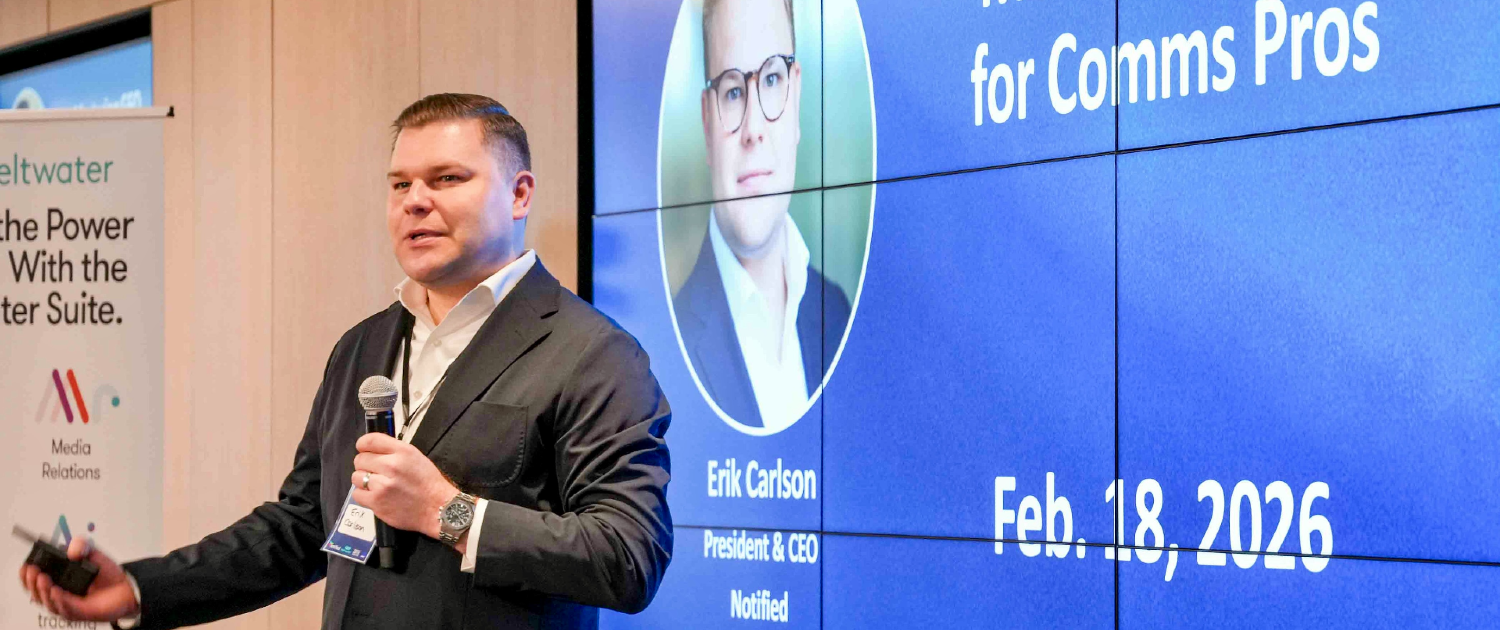
AI Visibility Is Earned: How Communicators Can Win in the Answer Engine Economy

How IR Teams Can Make Earnings Prep Easier and More Efficient