

Share this
by The Notified Team on Dec 12, 2025, 1:07:28 PM
You’ve read articles, scrolled through how-to guides and tried new tools promising to make PR and IR easier.But how often do you get to hear what really happens behind the scenes: the wins, the setbacks and the lessons that shape stronger, more confident stories?
That’s why we are excited to launch Behind the Storyteller, a new Notified podcast where real communicators share real experiences. No scripts. No jargon. Just honest conversations about what it takes to earn trust, prove impact, and make your story stand out.
With Behind the Storyteller, we’re creating a space where you can learn from peers, uncover new approaches and strengthen the way you share your message with the world.
What's Makes Behind the Storyteller Different From Other Podcasts?
Behind the Storyteller supports our mission to help communicators share clear, credible and impactful stories. This is not your typical “tips and tools” podcast.
It’s real conversations with real pros, your peers, who have faced the challenges you see every day. They explain how they overcame obstacles, built credibility and achieved results that you can apply to your own work.
It’s about creativity, courage and the human side of communication.
What You'll Learn in Each Episode
Each episode follows the storytelling arc we live by:
- Meet the character – A communicator dealing with a real-world challenge.
- Face the conflict – The problem, crisis or unexpected moment that changed everything.
- Discover the resolution – The lessons learned and actionable takeaways you can use today.
You’ll hear from communicators who have:
- Rebuilt trust after a crisis
- Navigated the intersection of AI and authenticity
- Transformed small ideas into global campaigns
- Taken lessons from one industry and applied them to another.
It’s storytelling about storytelling: honest, human and packed with insights you can use right away.
Watch and Listen To Our First Episode Featuring Gini Dietrich
We’re kicking off the series with someone who’s reshaped modern PR: Gini Dietrich, founder and CEO of Spin Sucks and creator of the PESO Model.
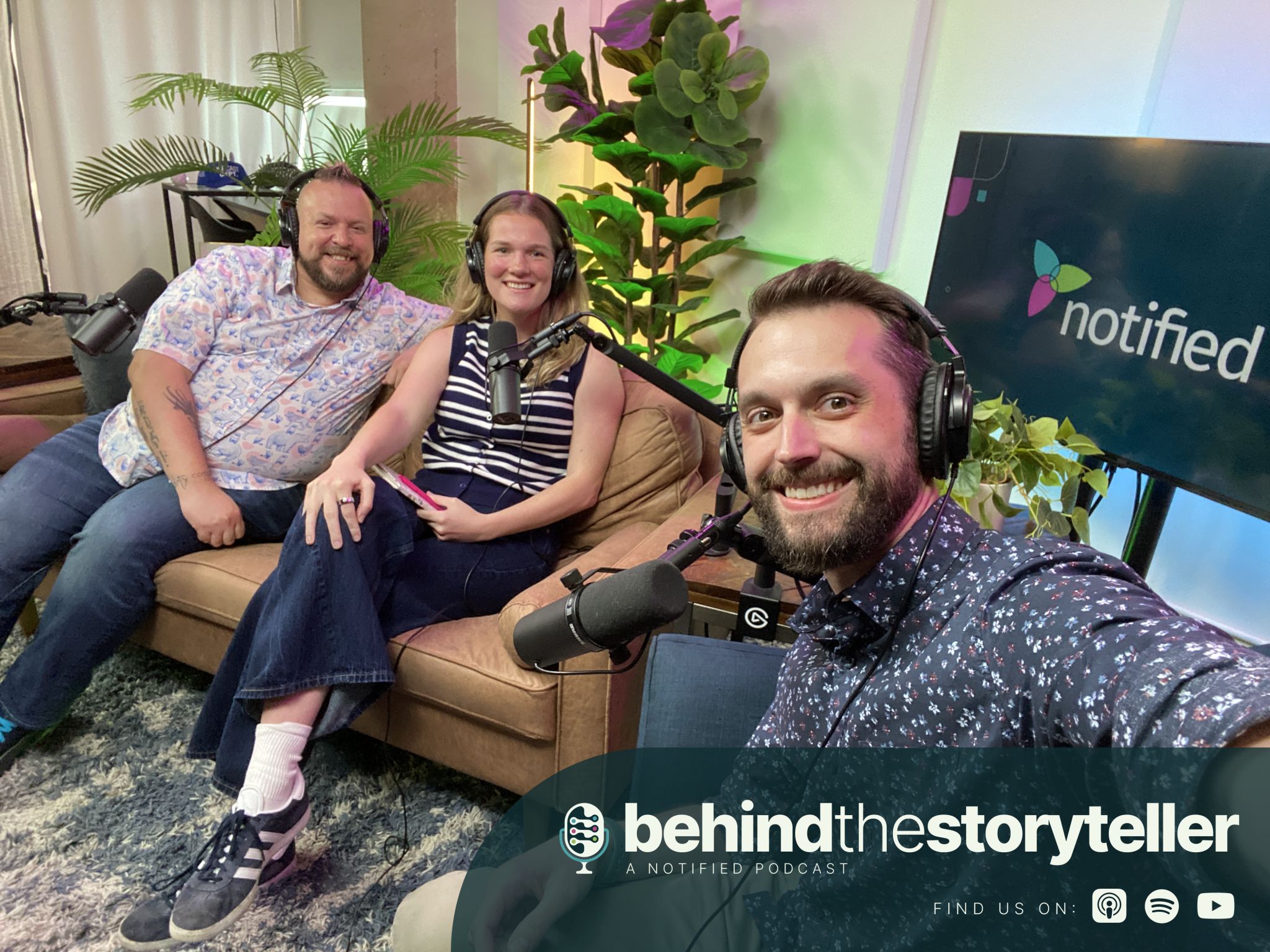
In our first episode, Dietrich joins our hosts (Notified’s own Allen Murphy, Caroline Cullinan and Pat O’Rourke) to talk about what it really means to own your story. She shares how she built a business from a blog, turned it into a bestselling book and what she learned when her framework became so successful that others began copying it.
Dietrich also breaks down how communicators can stay visible in an AI-driven world through visibility engineering which includes the practice of keeping your story consistent everywhere audiences and algorithms encounter it.
If you want insights that help you build trust, strengthen brand visibility and navigate the same challenges other PR and IR professionals face, you’ll want to start here.
Subscribe to Behind the Storyteller on Spotify, Apple Podcasts or YouTube.
Behind the Storyteller: A Notified Podcast - Episode 1 Transcript (Gini Dietrich)
Allen Murphy: Hello, my name is Allen Murphy, and this is the series where we take professionals from the worlds of IR and PR, the corporate storytellers and we get them in the studio here. Or today, we get them in the studio sometimes virtually, and we allow them to share their stories with insights, challenges, struggles, and takeaways that we can all learn from. I'm joined, as usual, by my co-host, Caroline Cullinan.
Gini Dietrich: Hi, everyone.
Allen Murphy: And Pat O'Rourke.
Pat O’Rourke: Hey, how's it going?
Allen Murphy: And we're super excited that we have a Chicago-based guest with us, which means we're not talking to a screen today. We're talking in person with Gini Dietrich. Gini, welcome.
Gini Dietrich: Which I'm so excited about. I was like, yay, we get to be in person!
Allen Murphy: This is awesome. Yay. And since you're here, normally I do introductions saying your job title, where you work, and everything, but you're here, so I don't want to talk for you. So please, talk.
Gini Dietrich: You forgot to look up the information beforehand.
Allen Murphy: Quiet. I'm editing that out. But I do know you've joined Notified webinars before, so some of our audience may be familiar with you. But for those who aren't, can you tell us a little bit about yourself, who you are?
Gini Dietrich: Sure. I'm Gini Dietrich. I have a firm called Spin Sucks. It actually started as a blog and then became a book. As part of that process, I created the PESO Model, which I launched in the book Spin Sucks—gosh, 11 years ago. It has become the framework that the PR and marketing industries use as a way to integrate work and measure efforts.
Allen Murphy: Excellent. Okay, we've got a lot to talk about. But before we get into Spin Sucks, the blog, the book, and everything like that, we do just want to get to know you a little bit. The way that we think about this podcast is that this is your opportunity to share your story. And a story starts with a character. You're our character today. So, let's hear a little bit about you. You're Chicago-based, have you always been a Chicago native, or are you a bit of a transplant?
Gini Dietrich: No, I'm a transplant. I've been here a long time, almost 25 years. But I grew up in Salt Lake City, Utah. I grew up Mormon. I'm not Mormon anymore, but I did grow up Mormon. I went to school in Omaha at Creighton University, then moved to Kansas City to work for FleishmanHillard, and then I moved here.
Allen Murphy: And how long ago, I guess I'm just going to jump into some of the stuff that you were talking about because I'm very interested. When did your blog start? Because that sounds like it was kind of the beginning of everything. Or was there a job or something that led up to that point for you?
Gini Dietrich: It's a good question. So, I actually left my job in, okay, and there were a lot of life changes. My fiancé at the time was moving to Chicago from St. Louis. We were getting married. There was a lot of stuff. So, I was freelancing, and I didn’t really have the intent of building a business. I was just going to freelance to get through the life changes and then go back to the big PR firm world.
I was the president of PRSA in 2007, and I made some really good contacts and really good friends, a lot of them who worked at big PR firms. They would say, “Oh, we’ve got this $200,000 client project that’s too small for us. Do you want it?” And I’d be like, “Yeah.”
Allen Murphy: Yeah, you said that number, and I’m like, oh, oh wait, no, they weren’t impressed by that.
Gini Dietrich: Not at all. Yeah, so for us it was great, and I just built an agency, which I didn’t mean to do at all, because I really was going to go back to a full-time job. I remember thinking, well, gosh, okay, we’ll try this, and if the other shoe drops and this doesn’t work out, I can go back. And now today I’d be like, no freaking way, I’m not going to go work for somebody again.
So as part of that, it started out as a very traditional PR firm. It was media relations, crisis, reputation. And we were inundated with social media, inbound marketing, blogging, and all this content that was coming at us. We were trying to figure it out. So we launched a blog in 2009 just to test it, to see if it was something we could offer to clients, and here we are. As it turns out, it was.
Allen Murphy: I feel like that was a good time to launch a blog too. Like, that was, I’d say, 2005 through maybe the mid-2010s. It was huge in the blog space.
Gini Dietrich: It was huge.
Allen Murphy: Yeah.
Gini Dietrich: It was fun too, because back then people commented on blogs. So it was really fun to build a community. It afforded me opportunities. I did Marketing in the Round first, co-authored that, and then I did Spin Sucks. It afforded me speaking engagements worldwide. I think in 2014, when Spin Sucks the book came out, I was on a plane 50 weeks out of the year. I don’t do that anymore. That was pre-children, but it afforded me a lot of really fun opportunities.
Allen Murphy: And so, what was the name of the blog itself, Spin Sucks, or is that something that kind of came over time?
Gini Dietrich: Yeah, it was funny because we were sitting in our conference room when we had an office back then, and we were talking about this blogging thing. We were like, does this make sense? Should we try it? How does it work? Can we offer it to clients? So we said, let’s launch one and see what happens. One of our really smart interns said, when we were talking about what to name it, “You always say spin sucks.” And I was like, that’s kind of a cool name. So we looked on GoDaddy, and the URL was available. So here it was.
Pat O’Rourke: I remember those days when you’d type in to see if the web domain was available, and then they’d give you all the options. It’s like “spinsux” with an X at the end instead of CKS.
Gini Dietrich: And you couldn’t do, back then, it was like you had to have the .com. You couldn’t do .net or .ai.
Pat O’Rourke: Yeah, nowadays it’s like .band, .blog, .whatever you want.
Allen Murphy: Total free-for-all for that last part of a URL now. But back then, nuh-uh.
Pat O’Rourke: If you didn’t have a .com, you were not legit.
Gini Dietrich: You were not legit.
Pat O’Rourke: Right. Yeah, a .co, I mean a .org, obviously that’s fine.
Gini Dietrich: Right, and .edu was fine, but outside of that, yeah, not good.
Allen Murphy: Yeah. And when did that evolve into a book that you had published?
Gini Dietrich: So, because of that, in 2011, my publisher, well, she wasn’t my publisher then—but she came to me and said, “Hey, I’m looking for a co-author for this book called Marketing in the Round. We need a PR expert. Can you co-author this book? It seems like you have a really good stance on the PR industry and Spin Sucks and things like that.” So, I worked with Geoff Livingston to write the book. He sort of taught me the publishing process, the speaking engagement process, and all of that.
At the end of 2012, which is when that came out, my publisher said, “So what do you want to do now?” And I said, “Well, I really want to write Spin Sucks.” And she said, “Great.” So, we published that in 2014. I always tell the story that it was due on December 22, and that week before Christmas she kept sending me stuff to do, and I was like, “Oh my gosh, I want it to be Christmas now.” But it came out and published.
Allen Murphy: So, you co-authored a book before writing Spin Sucks. Selfishly speaking, I’ve done some writing in the past too. What were some of the unexpected challenges between writing, you were used to writing a blog?
Gini Dietrich: Right.
Allen Murphy: Obviously much more short form when compared to a longer book. How was that transition from blog writing to co-authoring a book, to then writing your own?
Gini Dietrich: That’s a really good question. It wasn’t terrible, just because I was used to writing every single day, which I think when you write a book, you have to have that commitment and that routine. So I was already accustomed to that, and that part of it was easy. What I found most challenging was the curse of knowledge. I would write something thinking it made sense, and then, you know, they always have external experts read the manuscript draft. Feedback would come back, and I’d be like, “Oh.” So that was the most challenging part, having to go back in my brain to simplify it even more because you forget that people don’t know how things work.
Allen Murphy: Yeah, when you’re writing for an audience that you’re a part of, you can use jargon and terminology that you know they’ll get. But then when you throw in a business leader, a lot of that will go right over their head, and they’ll have no idea what you’re talking about. So, it’s almost like you have to unlearn some of what you’ve learned over the course of your career to rephrase it differently.
Gini Dietrich: Yeah.
Pat O’Rourke: Kind of like teaching your younger self again.
Gini Dietrich: Yes.
Pat O’Rourke: So saying, hey, what did I want to know, or how would I explain this to me before I became the expert in this, before I knew what that meant?
Gini Dietrich: Yes.
Pat O’Rourke: Yeah, I think about it all the time.
Caroline Cullinan: Because I coach lacrosse, so I coach kids. And I never realized the basics of it, right? Like you're talking, it's so hard to remember the basics when you're, you know, 28 years in.
Gini Dietrich: Yeah, and how do you teach it to a little kid?
Allen Murphy: Yeah, when that stuff is second nature to you by this point, after so much repetition, it's hard to dial it back. And so that kind of takes us more to about where you're at today then, right? So, and I guess this is a good segue. So we've learned a little bit about who Gini is, our character for the story. And we usually like to take this podcast to what's a struggle that you faced or an unexpected challenge that you came across within your industry. Let's talk us through it. What was the problem? What was standing in your way? Those sorts of things. I know we talked very briefly before we started recording.
Gini Dietrich: Which was 100 years ago.
Allen Murphy: But yeah, so what do you want to chat about today? What was something that you think maybe the audience could learn from?
Gini Dietrich: You know, I think there's one thing that across the board from a professional services standpoint, so if you're in marketing, PR, communications, law, or accounting, like, you know, providing a service, we forget that this goes back to the curse of knowledge and being an expert in things. We forget that we have intellectual property, and people want to pay for that. People want your expertise. They want to know what you have. And that might be in a salary or in consulting work. So you have to think about what do I know that I can share with an audience?
When I wrote Spin Sucks, the book, I talked about this. It wasn't even a framework at that point, but it was an idea that we had internally to help our clients have consistent results all year long. It involved bringing together content, blogging, social media, media relations, and search engine marketing back then. I remember one of the first iterations of the PESO model had Google Plus in it and Vine—things that don't even exist anymore.
Pat O’Rourke: I was like, you said Google Plus.
Gini Dietrich: Yeah.
Pat O’Rourke: Oh wow. I don't know what that is.
Gini Dietrich: Yeah.
Allen Murphy: That was a good attempt at a social media platform.
Pat O’Rourke: I used it.
Gini Dietrich: We all used it.
Pat O’Rourke: Yeah.
Gini Dietrich: It was kind of sad when they took it away.
Pat O’Rourke: Yeah. Wow.
Gini Dietrich: It was like a marriage between Twitter and Facebook.
Caroline Cullinan: Okay. Yeah, I'm unfamiliar.
Gini Dietrich: Yeah, it was super fun. But that was the first iteration. And when I wrote about it in the book, it was just to show that there's more to what we do than media relations. There's more to it.
And when you talk to an executive, I'm convinced that they go to some secret school at night where the teacher says, okay, if you want to make sales, here's what you do. You call a PR firm and say, I'll give you $10,000 to get me on the front page of The New York Times, and they'll get you there, and then everything will be solved. I'm convinced there's a school because that's all they want. And you're like, okay, that's not how this works.
Allen Murphy: It'd be great if it did.
Gini Dietrich: I wish it did.
Allen Murphy: Yeah.
Gini Dietrich: Unless you do something bad, you're not going to be on the front page of The New York Times. I'm really sorry.
Caroline Cullinan: You know, I've heard that before too. And I am not in the public relations agency world, but people have said that to me, and I'm like, I can't help you with that, unfortunately.
Gini Dietrich: No, you cannot. And when Oprah was here, people would call and say, we really need to get on Oprah, and I'd be like, great. She's not going to talk to you.
Allen Murphy: She hasn't answered my calls. I'm sorry.
Gini Dietrich: I live down the street, but she hasn't answered my calls.
Pat O’Rourke: Let me just ask her when we go to lunch next week. Close personal friend Oprah.
Gini Dietrich: Me and Oprah and Leonardo DiCaprio, we're just going to hang out next week.
Yeah, so I wrote about it in the book just to help people understand that it's more than that, right? And because a business leader was a target audience for the book too.
What I did not expect was that the industry would take this idea, this model and we did name it and include a graphic in the book, thanks to my publisher but I didn't expect it to take the industry by storm. And it did. Then people started to copy it and pretend they had created it.
Suddenly I had to backtrack and get trademarks and copyrights and all of that. Thankfully, I had it in a book, which helped significantly.
That has been one of the biggest challenges, and it still is today. I would say that most people are ignorant, they see something online and think, oh, that's cool, I'll make it my own without realizing there's a copyright law that prevents you from doing that. You can't make Coca-Cola and call it Coca-Cola.
So that has been the biggest challenge. I use that as an example because we all have intellectual property in our brains, things that we want to share. Be really smart about that before you do it to ensure your ideas are trademarked and copyrighted.
You can get that done fairly easily. You just have to prove that you've been talking about it that you have blog posts, curriculum, or something that shows you've been teaching or discussing it in some form. But do that, because it has been a struggle for sure, especially since we had to backtrack into it.
Allen Murphy: Yeah. That sounds like one of those unexpected challenges of success, when the book did so well and it was circulating through the industry so much. It's like, oh, now there's copycats that I have to deal with. Probably not something you thought you would have to deal with.
Gini Dietrich: Never, ever, never. And that's what I always tell people, protect your ideas.
Allen Murphy: Yeah. So we're going to have to do that for this podcast, so there's not another Modern Story.
Gini Dietrich: That's right. Yes. You'd be surprised. There might be one in Europe where they're like, oh, they're in the US. And you can't do that.
Allen Murphy: We're going to see a knockoff where there's a host with different colored Mohawks and loud printed shirts.
Pat O’Rourke: Right. Yeah. No, to your point. In a previous life, I hosted karaoke and I branded it a certain way. There was a lot of talk about trying to trademark that because people will utilize the same name or the same idea. You don't always, when you start something, or in your case with the book and putting this together, expect it to take the PR world by storm. You don't sit there and go, should I trademark this beforehand? You don't necessarily have that thought unless you are intentionally creating a new course or a new thing. Then you can get ahead of it and say, okay, here are the steps to protect this, to trademark this. I can only imagine that when it started taking off, and you have these people saying, oh, this is what I came up with, it must have been challenging. But it was fortunate that you had it in the book, with the graphs and all the material there. Has there been a particular challenge from an organization or a person utilizing this that turned into something memorable where you had to be like, no, this is mine?
Gini Dietrich: Yes. In fact, there is a company that created a whole marketing and sales process around it—an e-book, landing pages, lead magnets, the whole thing. The whole thing.
The way I normally approach it is I'm a fairly reasonable human being. Usually what I do is reach out to someone I know inside the organization or directly to the person who posted it, because you can see it online. I just say, hey, listen, this is great, but you can't really do that. It's copyrighted. There are several ways we can work on this. If you're going to do a landing page or lead magnets, you have to pay for that. If you're blogging about it or using it in a presentation because you're teaching it, I can give you a free license for that, but you have to attribute it to me. That's what we ask.
But these guys, I was like, okay, we have to talk about licensing. They were like, oh, sorry. They took everything down because our attorney said it was not okay. They took everything down and then republished it a month later, thinking we wouldn't see it again.
Caroline Cullinan: Just need to forget about it.
Gini Dietrich: Yeah. Like they were suddenly off your radar. And we were like, no, you can't do this. Our attorney, Mark, worked at this point. It had escalated. Our attorney had worked with our legal team and they took everything down in the US, but not around the world. So then we had to go back and say, you guys, you cannot do this. At this point, I'm even still willing to work with them to say, if you license it, I'm happy to work with you on this. You don't have to. Oh, I know how much work went into this. I know how much money you spent getting this done. I'm happy to work with you to get this right. And they just kept trying to undercut and move. I really think they are a big enough company that they thought I would go away. And I did not go away.
Allen Murphy: Good.
Gini Dietrich: And I just got a check for it like three weeks ago.
Allen Murphy: Right.
Pat O’Rourke: So glad to hear.
Allen Murphy: It's good that you weren't immediately just trying to lawyer up. You're trying to work with them. You want the information to be out there. That's why you made it in the first place. You want to help the respective industries. So you're not trying to just shut it down immediately. You're like, hey, I'll work with you guys. But every opportunity they were trying to just.
Gini Dietrich: And they did. It was like four times. After the fourth time, my attorney was like, oh, come on.
Pat O’Rourke: It's a little web. It's not like you can just hide it. Yeah. I mean, back in the day, back in the olden times, Caroline.
Gini Dietrich: Before you were born.
Pat O’Rourke: Yeah. Dinosaurs roamed the Earth. I was a kid.
Gini Dietrich: Big Bang Theory. Little buggies. Dial-up phone.
Pat O’Rourke: Exactly. Cranking up the car before you even get it to start. You could almost kind of get away with stuff like that. I'm sure there were plenty of instances where that happened because in this exact case, if you stop doing it in the US and you don't have presence in the UK or Europe or Asia, and they're still putting these things out, then okay, then they can get away with it. But in this day and age, the internet is worldwide. It doesn't matter where you are. You can see these things.
Gini Dietrich: And there's this little thing called media monitoring.
Allen Murphy: We're very familiar. Yes.
Gini Dietrich: As it turns out.
Allen Murphy: Shameless plug for media monitoring. And you mentioned, kind of talking about the olden days and everything, grandpa. So we're going to have a super cut of episodes where we're joking about your age eventually.
Caroline Cullinan: And me just looking at the camera.
Pat O’Rourke: We're talking about how my back hurts as soon as Caroline's like, I don't know what that is.
Allen Murphy: But when you were talking earlier about your blogs, and then we mentioned it was Google Plus and everything, and now things have evolved a lot over the last few years, especially with AI. But before, a lot of the topics were about search engine optimization. Now it's more like answer engine optimization. How is that affecting a lot of what you do and the teachings and the takeaways?
Gini Dietrich: So much. In fact, this entire year we've spent on visibility engineering and using the PESO model as your operating system. So it's really about how large language models are learning. They're learning by consistent messaging across everywhere, right? Everywhere. Social, website, content, paid media—everywhere that you have a presence, that message has to be consistent. And they're learning by citations, which makes media relations really important. So if your content on your website matches what the media is saying, matches the social, matches your ads, all of that starts to work together. Where I think most companies are falling down right now is they're not consistent. You might have the CEO's bio that's one way on the website and completely different on LinkedIn. That confuses the AI so it doesn't do anything. It's like, oh, I don't know what to do with this, so I'm not going to do it. We talk a lot about how to engineer that visibility. It really is making sure that your messaging is consistent across all the platforms. You have your messaging pillars and your key messages that line up underneath those. Are they the same? Are they consistent? Does a consumer see you wherever they are and get the same message on TikTok that they would on Reddit or elsewhere? The same thing goes for the AI. Is it getting the same message? A lot of what we've been working on this year is how to engineer that visibility for both humans and robots.
Allen Murphy: That's really interesting. More and more companies are trying to get their messaging out there as widely as possible, thinking this way AI can find it and make it part of the results. But a lot of them don't realize that consistency is so important. That's very interesting.
Gini Dietrich: Yeah, I think it's probably one of the most important things. Otherwise, the AI is like, I don't know which is true, so it just ignores it.
Allen Murphy: Yeah, if it doesn't know what to do with it, it's not going to do anything.
Pat O’Rourke: Or worse, that it just makes up its own thing.
Gini Dietrich: Right, it could hallucinate. Yeah, for sure.
Pat O’Rourke: It's like, well, we'll fill in the gaps for how we think with all the information. Yeah, keeping your story, keeping control of your story through AI is huge right now.
Allen Murphy: Yeah, the last thing you want for your brand is for AI engines to make things up about it or anything. Yeah.
Gini Dietrich: Or look at old stuff and use that as the new way of doing things. So it's interesting because I just had somebody say to me, I don't understand why you haven't evolved the PESO model. And I was like, have you been on the internet lately? Because we have. All you have to do is ask ChatGPT, because I've been so strategic and purposeful about ensuring that the LLMs know. I literally said, why don't you open ChatGPT right now and ask it, has the PESO model evolved in 2025? So she did, and she goes, oh, and I was like, thank you.
Pat O’Rourke: You're like, microphone drop.
Gini Dietrich: Don't come at me until you do your research.
Pat O’Rourke: That would have been a point in time back in the day where she would have hung up, slammed the phone. I remember those days.
Caroline Cullinan: When I was, you know, five years old. Right.
Gini Dietrich: When she saw her mom do that. Yeah. Exactly.
Allen Murphy: As this series goes on, you're just going to get older and you're going to get younger.
Gini Dietrich: Right.
Pat O’Rourke: Sounds about accurate. Yeah, that works.
Allen Murphy: Jenny, we're coming up on the 30-minute mark, and this is usually when we want to think of some key takeaways, some good sound bites that the audience may like to learn from you. For anyone watching this, whether they've seen you on our webinars before, whether they've read your book, pick up her book. What are some things that you think, especially now, with regard to maybe AI or just the way industries and the world have evolved, some key takeaways that people could learn from this episode today?
Gini Dietrich: A couple of things. I would say, number one, you have to be really good at marketing to human beings before you can market to robots. If you're not good, or the organization is not good at marketing to humans yet, which I would say is probably the case for 75%, not the fault of us, because there are executives who don't always value the work that we do. That's the first step. But you also have to understand that you have a new brand persona now in ChatGPT, Perplexity, Gemini, and all of those. Really think about how you're going to market and communicate to both the robots and the humans. I think that's the big thing. Then really understand how you can start to engineer that visibility. Starting with the PESO model, I would start with owned and earned and then move into shared and paid.
Allen Murphy: And they make—because I do feel like more and more industries are really just trying to talk to those AI models. But you're right, talking to those AI models doesn't really matter, because at the end of the day, it's people who are getting those results. So you need to know how to market to the people who are.
Gini Dietrich: They're the ones who are going to buy.
Allen Murphy: Exactly. Yeah. ChatGPT doesn't have a wallet and just throwing down the credit card.
Pat O’Rourke: ChatGPT is like, "Please buy us. We'll keep telling you more things than what to buy."
Gini Dietrich: That's exactly right.
Allen Murphy: Ginny, thank you so much.
Gini Dietrich: This was so fun.
Allen Murphy: Yeah, this is great. I may ask you to come back because it was so much fun. For everyone listening or watching at home or on your commute, however you're taking this in, thank you so much for joining us today. And Ginny, we hope to have you back soon.
Gini Dietrich: I would love to come back. This is super fun.
Allen Murphy: Thank you. Bye-bye.
About Notified
We are Notified, and your story goes here. As the only technology partner dedicated to both investor relations and public relations professionals, we help you control and amplify your corporate narrative. Our fully integrated PR and IR platforms streamline every step—whether it's reaching the right media, press release distribution, and measurement or designing new IR websites, managing investor days, earnings releases, and regulatory filings. Connecting both worlds, GlobeNewswire is one of the world's largest and most trusted newswire distribution networks, serving leading organizations for over 30 years. Together, we empower communicators to inform a better world.
Notified is an affiliate of Equiniti Group Limited (EQ)
How tonies Brought Its Investment Story to Life for Investors Everywhere

Why AI Visibility Measurement Belongs to Public Relations

How to Measure AI Search Visibility Without Chasing a Score