

Share this
by The Notified Team on Apr 7, 2026, 9:00:41 PM
After leading product development, heading global operations and listening to client feedback, Erik Carlson, President and CEO of Notified, had a clear view of how success was measured across the PR industry.Then, about a year ago, he noticed something strange: the numbers PR teams had trusted for years were dropping.
Audiences are no longer just searching - they’re asking AI for answers. And that shift is redefining public relations success. It’s not just about driving traffic. It’s about showing up in answers, being understood and earning trust.
So, what does the future look like? Erik recently sat down with Tech Edge to discuss how you can maximize citation potential and stay ahead of the curve. Watch the full interview below.
Key Takeaways
- It’s time to stop only relying solely on clicks and website traffic. AI search is changing how people find information.
- Focus on brand citations - your content needs to show up in AI-generated answers to stay visible.
- Invest in press releases and earned media strategy - AI systems trust credible, high-authority sources.
What Are Brand Citations? Why Do They Matter in AI Search?
The scoreboard has changed.
Today, it’s not just about how many people visit your content. It’s about whether your content is being used. This is the rise of brand citations.
Think of brand citations as the AI-era equivalent of media placements - only instead of being read by people, they’re picked up by answer engines that influence millions of micro-decisions every day.
In practical terms, it means asking:
- Is your brand being referenced by AI tools?
- Are your announcements or media mentions showing up as sources?
That’s where visibility is moving. And it’s a big shift - from measuring traffic to measuring influence.
This shift is also impacting the broader media ecosystem. As fewer users click through to websites, publishers are seeing traffic decline - forcing a rethink of traditional advertising models.
As highlighted in the conversation, some AI platforms are already exploring new ways to introduce advertising directly within AI experiences. It’s a clear signal that this isn’t a small change - it’s a full reset of how content is consumed and monetized.
Do Press Releases and Earned Media Still Matter in the AI Era?
One of the strongest points from the conversation is this: AI doesn’t rely on a single source. It looks for patterns.
That’s where PR has a real advantage.
Press releases bring structure and verified information. Earned media adds credibility and third-party validation. Together, they help create the kind of consistency AI systems look for when deciding what to trust.
It’s also why releases are seeing a resurgence (see this case study). When distributed through trusted networks, they don’t just share news - they reinforce authority.
How Do AI Systems Decide What Content to Trust and Cite?
One of the most important ideas Erik shared is that AI models are consensus engines.
They don’t just look for one mention. They look for multiple signals that point to the same story. That means your website alone isn’t enough.
You need:
- Owned content (your narrative)
- Earned media (third-party validation)
- Distributed content (reach and repetition)
What is the SOAR Content Framework? How Does It Improve AI Citation Potential?
As AI search continues to grow, one thing is clear: not all content performs the same.
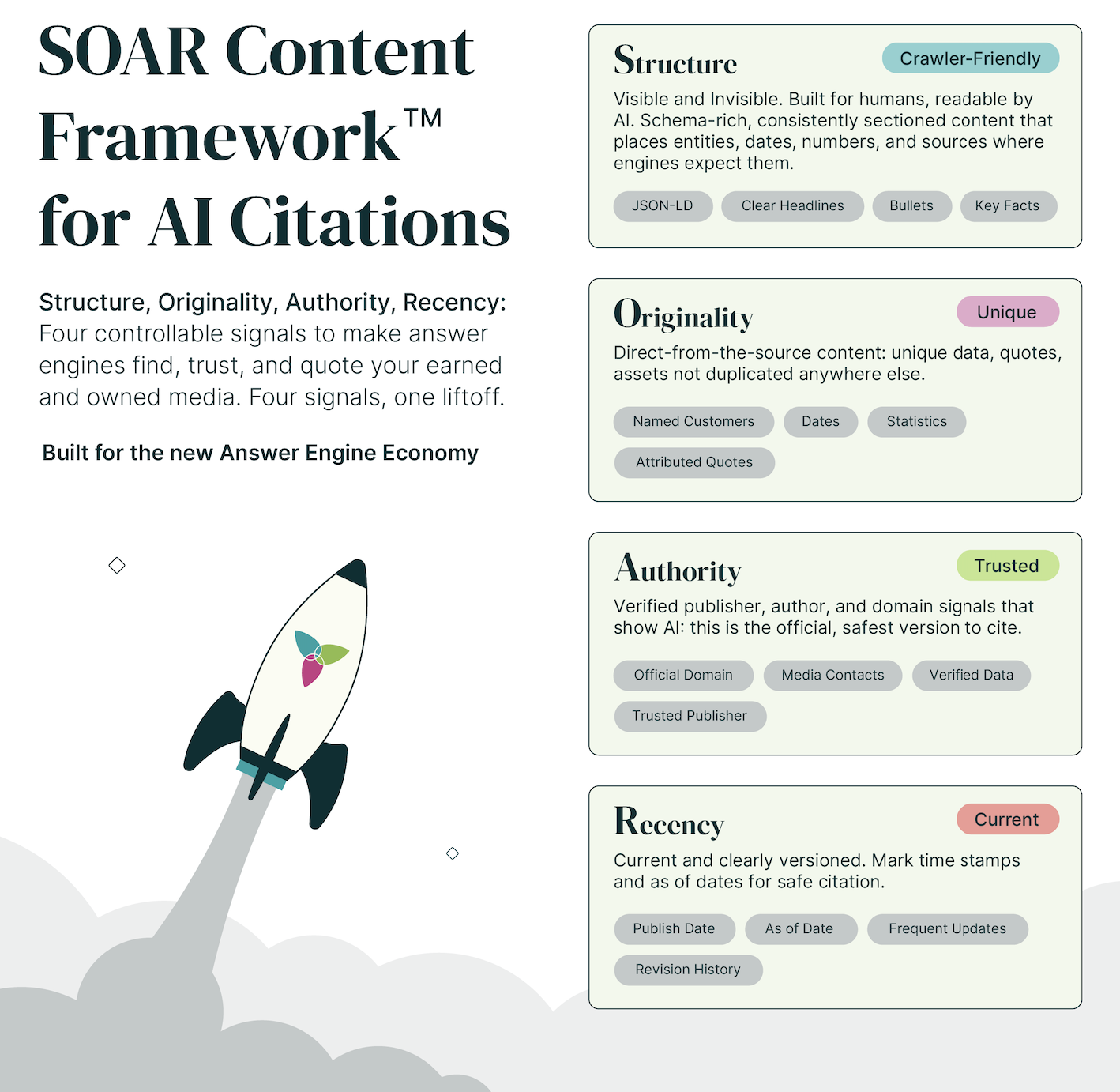
The SOAR Content Framework™ is designed to help you create content that is easier for AI systems to understand, trust and cite.
It’s built around four key elements that directly influence how content shows up in AI-generated answers:
- Structure – Content should be clear, well-organized and easy to scan. Elements like strong headlines, subheadings and FAQs help both people and AI systems quickly understand the message.
- Originality – AI systems prioritize content that adds something new. Unique insights, expert perspectives and fresh data make content more valuable and more likely to be referenced.
- Authority – Publishing through trusted sources matters. High-quality distribution, credible media coverage and strong domain authority all signal that your content can be relied on.
- Recency – Timely content performs better. Keeping information up to date increases the chances of it being surfaced in relevant AI responses.
When these elements come together, content becomes more than just visible. It becomes usable, citable and more likely to appear in AI-generated answers.
How Is Notified Helping PR Teams Improve AI Visibility?
That’s where Content OSTM comes in - bringing planning, distribution, amplification and measurement into one connected system.
And more importantly, it’s where our recent innovations within our operating system are making a real impact:
- Our AI Press Release Optimizer uses the SOAR principles to help improve release structure, clarity and context within the PR workflow before distribution. This ensures content is easier for AI systems to understand and cite.
- Through an industry-first partnership with Profound, you can see how your GlobeNewswire press releases are cited by chatbots, answer engines and AI search summaries.
- Syndicated Articles take that same release content and extend it into journalist-style articles across trusted media sites - helping build the authority and credibility AI models rely on. Syndicated Article Reports then close the loop, giving clear visibility into where this content appears and how it performs.
All of this ties back to core idea Erik emphasized: visibility today is not just about publishing - it’s about being understood, trusted and repeated across sources.
Erik Carlson March 2026 Tech Edge Interview at NYSE - Conversation Transcript:
John Giannarone: Hi, it's John Giannarone, editor-in-chief of Tech Edge. Thrilled to be here at the New York Stock Exchange with one of our favorite guests. We've got Erik Carlson, who's the President and CEO of Notified. Erik, thanks for joining us. Nice to be here again. So, Erik, for those of our viewers who have not seen you before and aren't familiar with the company, can you tell us a little bit about the business and what it's all about?
Erik Carlson: Yeah, absolutely. So, Notified is the only integrated PR and IR communications company and software provider in the world. What that tactically means is we provide corporate communication solutions for public relations communicators and marketers, and investor relations professionals as well. And when you think about the two different industries, what really unites them at the end of the day is both professions are corporate storytellers. And I think that's what we're going to talk about today when we talk about how folks are getting their information and the way that that's changing how you think about media, building brand visibility and earning trust.
John Giannarone: Great. Now, in the green room, you and I were just having a chat about something which is very important to me, running a media company, which is this shift from traditional search engine optimization, SEO, to this world where people are just looking for answers and not necessarily website results. So, tell us, how has that impacted your world when people are not necessarily looking for websites to click on, but just to get an answer?
Erik Carlson: Yeah, well, it's funny, last time that we were together and I was on the show, we talked about our partnership with Profound. And really where that came from - Profound is one of the leading companies in terms of AI visibility and software tools to actually manage and measure what your share of voice is in this new answer engine economy. Where that partnership came from was about 12 months ago, I woke up in a cold sweat. And I said, look, if you think about the PR side of our business, so much of the ROI that we use to demonstrate came from exactly what you're talking about - clicks on websites, unique views, placements. And with the shift to natural language models and people searching directly in answer engines, that's now going away. And so, I sat there and said, well, if the scoreboard has changed, how are we going to measure it on the other side? And what's happening as the shift has taken place, largely over the last 6 to 12 months, and we'll talk about the pace of it - is we're now measuring share of voice and brand visibility in this new currency we're calling brand citations. So, if you're in an answer engine, how likely is it that your brand's owned material or earned material, talking about your brand, is showing up as a source or a citation? And what is that doing to your brand's visibility within the larger LLM ecosystem?
John Giannarone: That makes a lot of sense. One thing we were also talking about in the green room here was the impact on advertising. If I'm not clicking on websites, does that mean that advertisers are not getting as many hits as they did before?
Erik Carlson: 100%. Look, I think the industry is ready for a shakeup. So, you've got publishers who have to think about new ways of monetizing their content. You've got audiences who are not going to those downstream digital properties anymore but are natively looking for information in LLMs. And so, you've seen different LLM providers take different approaches to it. OpenAI mentioned they're going to start introducing advertising. That's to offset some of that lost digital property traffic that you're seeing on publisher sites.
John Giannarone: Gotcha. Let's talk about the SOAR content framework. Tell us about that.
Erik Carlson: Yeah. So, you know, over the course of our partnership with Profound, we've monitored over 200 million citations. And behind those citations, each citation tells a story. What we've learned is we looked at how content performs, what content is over-indexed in LLMs versus under-indexed. There is a hierarchy in terms of preference. That hierarchy is really, at the end of the day, owned - so what's on your website, what is the content that you're disseminating as a brand, whether you're an IR team doing a financial narrative disclosure or you're a PR team telling a brand story - then it's earned. And the reason earned is really, really important is because you might have the authority as an owned source to write something about your company. But at the end of the day, LLMs are consensus engines. And so, they're looking for multiple sources that have high domain authority and originality that essentially create a consensus around the information that you're publishing. And so, what we did was we looked at all of this information across these citations, and we created a really practical framework for corporate communicators, advertisers and marketers to step back and say, what can I control when it comes to my brand's visibility? It boils down to four key tenets. The first is structure, right? So, SOAR stands for Structure, Originality, Authority and Recency. On the structure side, we like to say there’s invisible and visible structure. Visible structure - we’ve been doing it for a long time. It’s FAQs in written content. It’s really clear titles and sub headlines. On invisible structure, it gets pretty technical. It’s things like metadata tags on your website, and to get really technical, JSON-LD. And so that’s a way to actually translate that visible content for machines to be able to read it.
John Giannarone: That’s really interesting. Just for our viewers who might not be familiar with that term, you mentioned domain authority - it’s pretty straightforward. So, something like the Wall Street Journal is like 100, right? It’s perfect, you know, and then smaller, less trafficked websites are going to be a fraction of that, correct?
Erik Carlson: Are going to be a fraction. And, you know, one of the questions people are asking, particularly in the media landscape, is: why are press releases having a little bit of a resurgence at the moment? It’s because they’re high domain authority sites with editorial control. And so, when you’re thinking about informing that LLM, or that new answer engine, that the owned content you’re publishing on your website is authoritative, having a press release back that up becomes really, really valuable.
John Giannarone: That’s a really good tip to know. So, tell us a bit about Notified’s content operating system, Content OS.
Erik Carlson: Yeah, absolutely. So, within this new ecosystem or landscape, when you think about how PR is shifting, there are really two things you have to manage, right? We talked about building consensus. And so that means distributing consistent content across a myriad, or a wide array, of channels. So, we built what we call Content OS. It all starts with the press release. That can be the forcing function or the narrative - the forcing document - of any PR campaign. From there, it’s really about how do I amplify that across shared channels. So that could be social publishing. It could be earned channels - how do I build syndicated articles or editorial bylined articles that add authority back to that content that I’m providing? And then obviously your owned channels, so your website. So, it’s really completing, if you go back to the traditional marketing model, the full PESO model - paid, earned, shared, owned - covering the earned, shared and owned piece because paid doesn’t index very highly in terms of LLMs.
John Giannarone: Gotcha. I’ve got a question for you. I’m not sure if it’s a good one or not, but I’m just thinking about how much time people spend on social media, and those are inside of apps. Do the LLMs actually track that stuff? Let’s say I made an Instagram post, and it gets a gazillion likes. Will that inform the AI answer?
Erik Carlson: So, short answer is yes, right? LLM bots are indexing social websites all the time, whether that’s X or BlueSky or Threads or LinkedIn or Instagram. The weighting of it depends on the model. So lately, LinkedIn is getting a lot of traction in terms of being a high-authority domain that LLMs are beginning to cite. Reddit had a spike for a while in Q4 and early Q1, but that has sort of faded. And so, what’s really important to remember is this is a dynamic industry. We’re still figuring out where these LLMs end up landing in terms of content they’re indexing and prioritizing within the answers they serve.
John Giannarone: You know, it’s interesting. You’re making me think more about LinkedIn. Something that I’ve always observed about LinkedIn is more of a civilized discussion because people have their names on there. On Twitter, you get all kinds of trolling and that sort of stuff. I mean, I think in my entire life, I’ve had one troll on LinkedIn. They just don’t - you know what I mean? So, do you think that with most of these models, LinkedIn ranks higher than some of the other ones where it can be an anonymous account?
Erik Carlson: Yeah, I mean, I think that goes back to the authority point, right? So, if we go back to the SOAR content framework - Structure, Originality - the “A” is Authority, right? Who are you? Do you have the right to talk about this topic? And are you perceived as a thought leader in that space? LinkedIn is a great ecosystem to prove out that model, which is why it’s indexing really favorably right now.
John Giannarone: That’s really interesting. So, let’s talk about 2026. What is the strategic North Star for Notified?
Erik Carlson: God. So, you know, for me, I wake up every day and I say, we’ve been a really reliable communications provider for a long time. The ecosystem is changing. How do we go from communications to insights? And I think that’s a function of a couple of things. You’re seeing it across the industry. People are looking for ways to save time and to drive outcomes so that they can focus on what matters. And so, we’ve taken a similar task with our product. We’re embedding AI everywhere, and we’re figuring out how we help communicators - whether you’re on the IR side or you’re talking about corporate communications and your financial narrative - communicate with intent what matters, what’s going to move the markets, and ultimately do it in a way that’s efficient.
And practically, what that means is we’ve released market intelligence over the last three weeks. That’s essentially a module within our IR platform that allows you to monitor what’s going on in the ecosystem, craft your earnings release, work on supposed questions in Q&A, and do that all with an AI layer. We’ve done press release optimization this year, which allows you to take a press release or a piece of narrative content that you’ve written and apply the SOAR content framework.
So it all comes back to: are you controlling what you can control to maximize your message and make sure, at the end of the day, because you’re not just communicating to customers directly or shareholders directly, you’ve got a middleman in the middle now - and it’s the LLM - that what’s being interpreted and ultimately answered is high fidelity and on narrative and on brand.
About Notified
We are Notified, and your story goes here. As the only technology partner dedicated to both investor relations and public relations professionals, we help you control and amplify your corporate narrative. Our fully integrated PR and IR platforms streamline every step—whether it's reaching the right media, press release distribution, and measurement or designing new IR websites, managing investor days, earnings releases, and regulatory filings. Connecting both worlds, GlobeNewswire is one of the world's largest and most trusted newswire distribution networks, serving leading organizations for over 30 years. Together, we empower communicators to inform a better world.
Notified is an affiliate of Equiniti Group Limited (EQ)

Rethinking Investor Engagement When AI Shapes the Answer

The Click Is Disappearing. The Buyer Isn’t: How to Win in AI and Zero-Click Search
.png)
IR Has Entered the Real-Time Era. Can Your Technology Keep Up?